
Who this plan is for
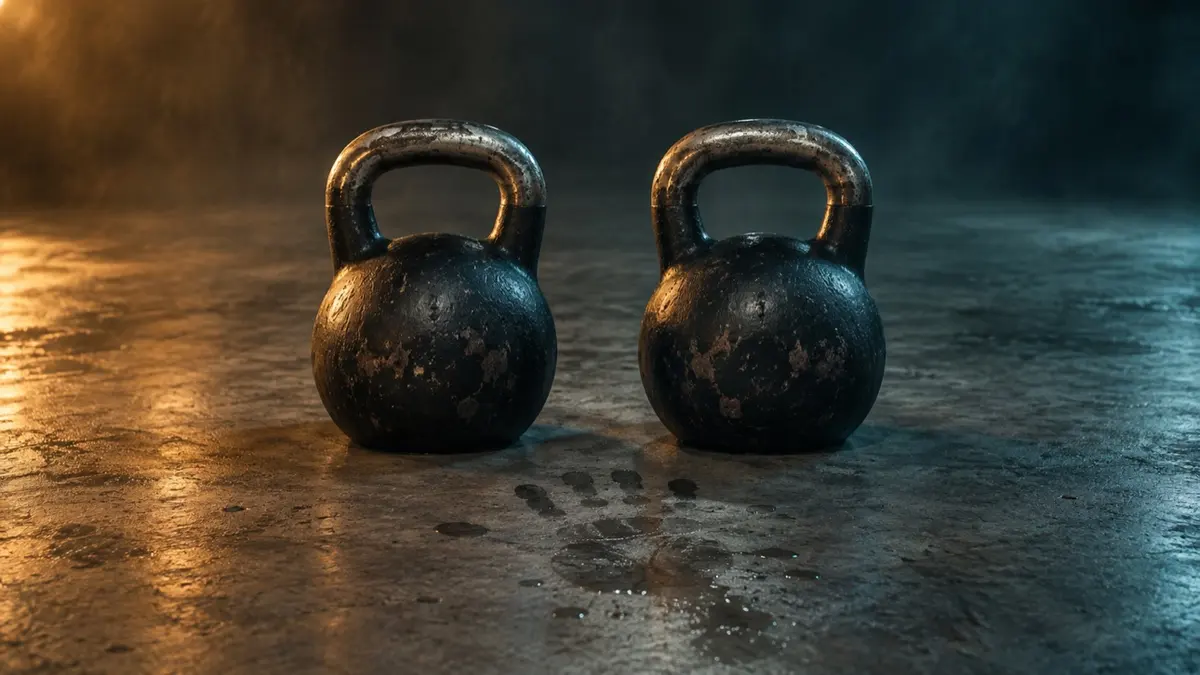
A kettlebell and a few square meters of floor make a small gym. The plan above is for beginners and for lifters new to kettlebells: three full-body sessions a week, each with a hip exercise, a press, a pull and work for the trunk. A single bell covers the first weeks; a second, heavier one comes in when the swings get easy.
Pick another plan if:
- Your goal is the heaviest squat or deadlift you can build. Over 6 weeks, weightlifting with heavy back squats raised squat strength more than kettlebell training did (Otto and colleagues, 2012). The beginner strength program is built for that.
- You have no weights at all. The bodyweight workout plan needs a table, a chair and a step.
Choosing your bell
Let the press decide: take the heaviest bell you can press overhead with one arm for about six clean reps. The hip exercises, the swing, the deadlift and the high pull, can take more weight than the press, which is why a second, heavier bell is the first thing worth adding.
| Exercises | Which bell |
|---|---|
| Presses, rows, the get-up, the windmill, the halo | The one you press about six times |
| Swings, deadlifts, the high pull, the lunge, the squat, the carry | The same bell at first, a heavier one when it gets easy |
Kettlebells often come 4 kg (about 9 lb) apart, so the next bell is a big step: from 12 kg to 16 kg is a third more weight. That decides how you progress, below.
How the week works
| Monday | Wednesday | Friday | |
|---|---|---|---|
| Session | Kettlebell Full Body A | Kettlebell Full Body B | Kettlebell Full Body C |
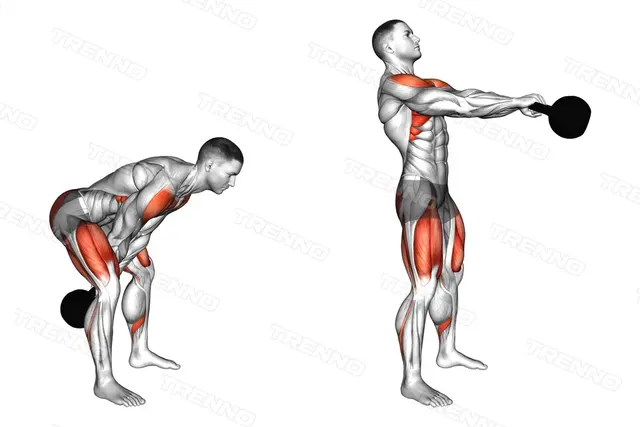
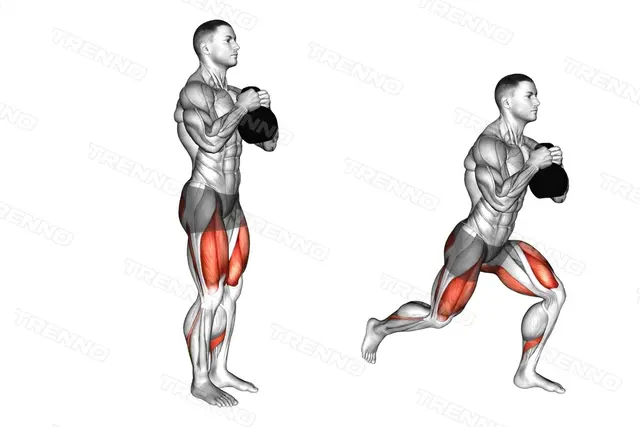
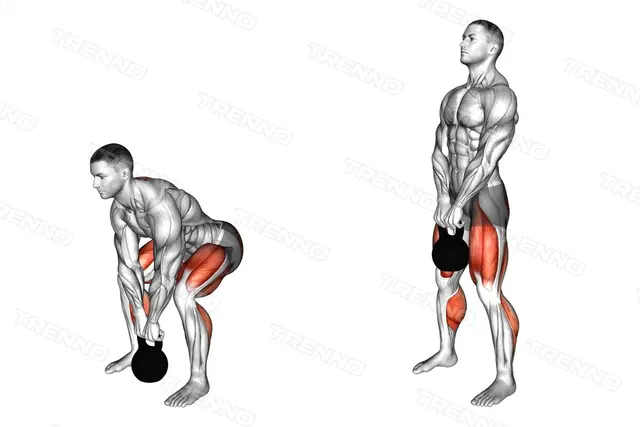
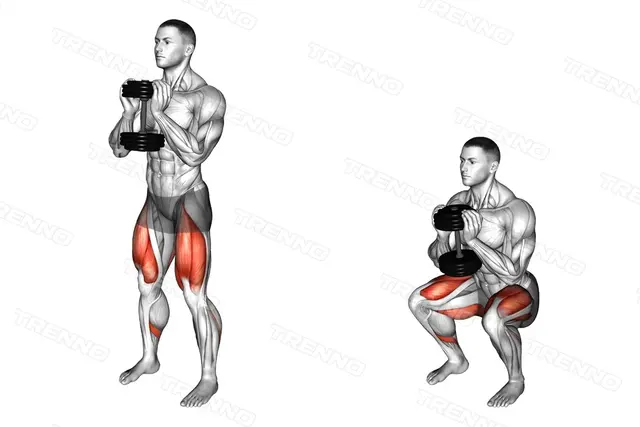
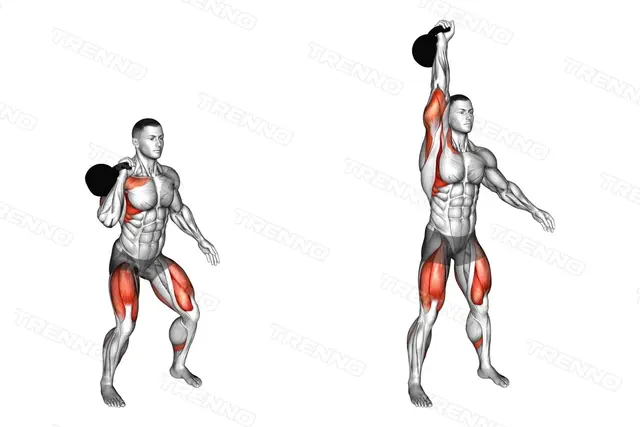
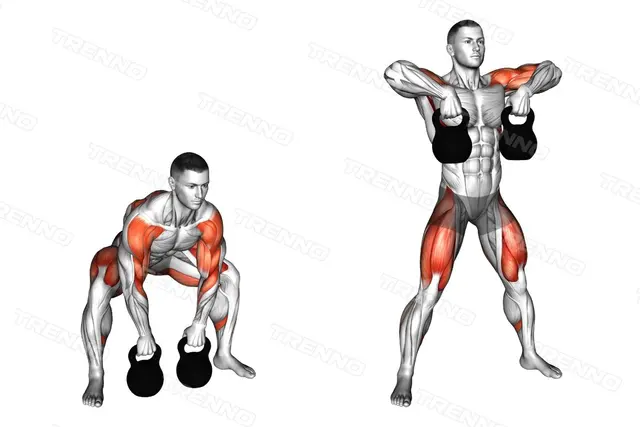
| Lower body | Kettlebell Swing, Kettlebell Goblet Reverse Lunge | Kettlebell Deadlift | Goblet Squat, Kettlebell Sumo Deadlift High Pull |
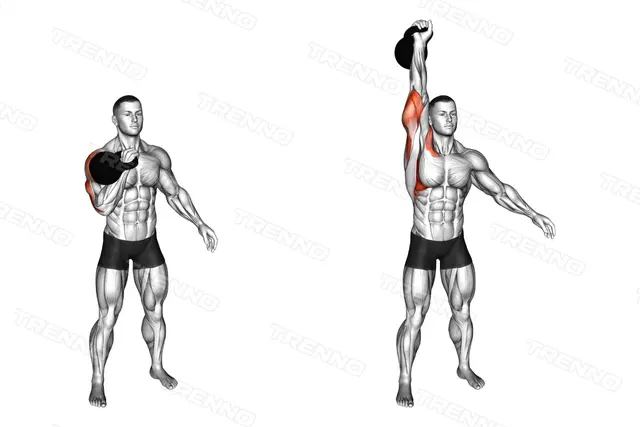
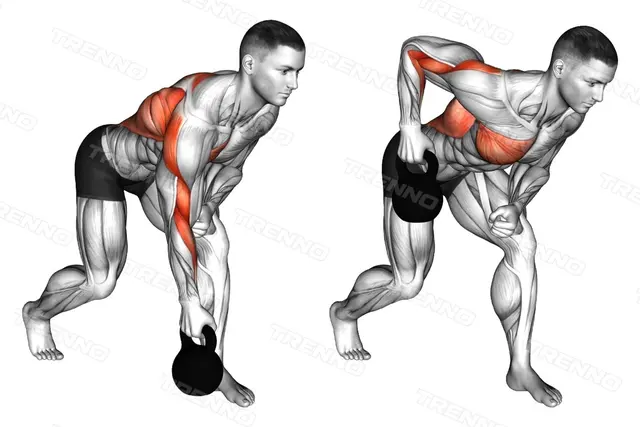
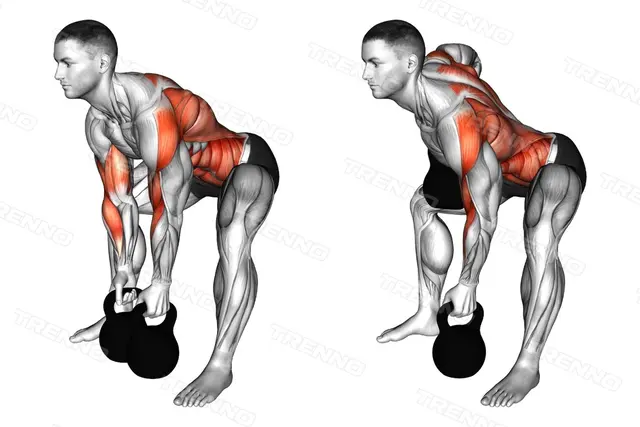
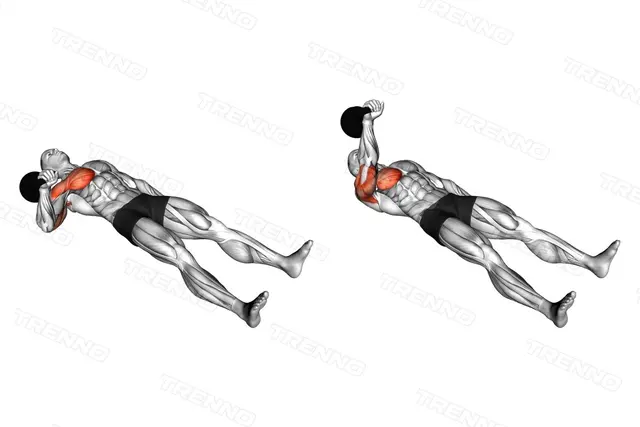
| Upper body | Kettlebell Overhead Press, Single-Arm Kettlebell Row | Kettlebell Clean and Press, Kettlebell Gorilla Row, Kettlebell Floor Press | Kettlebell Push Press |
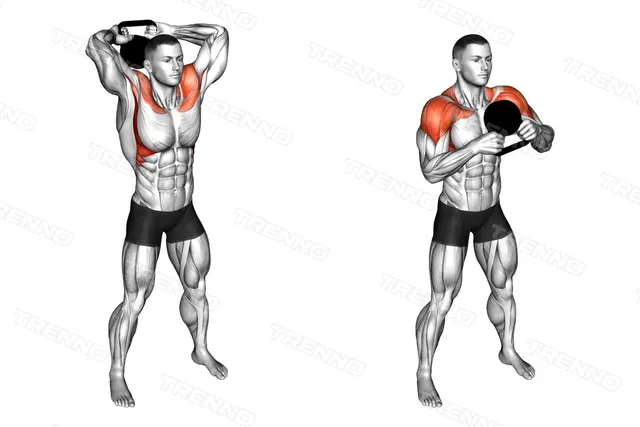
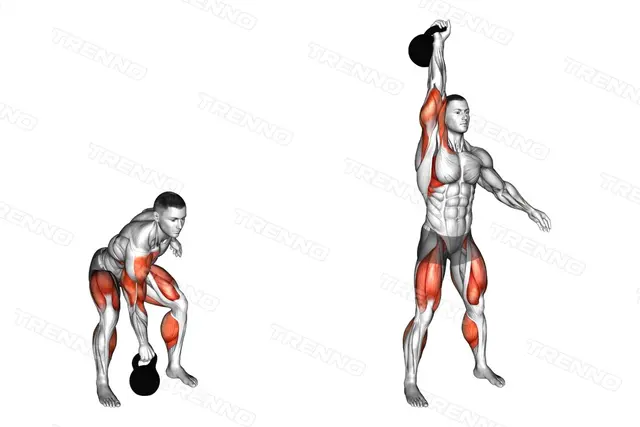
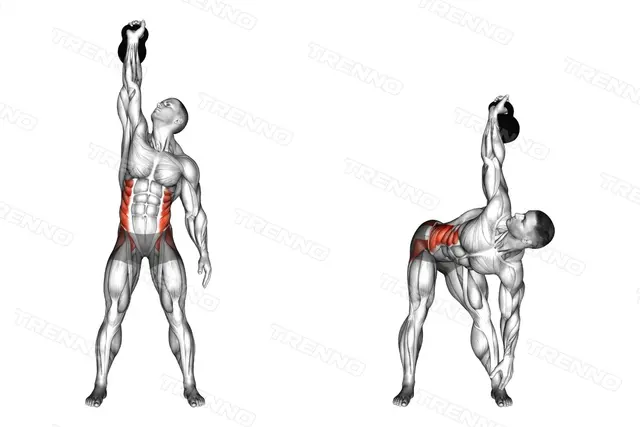
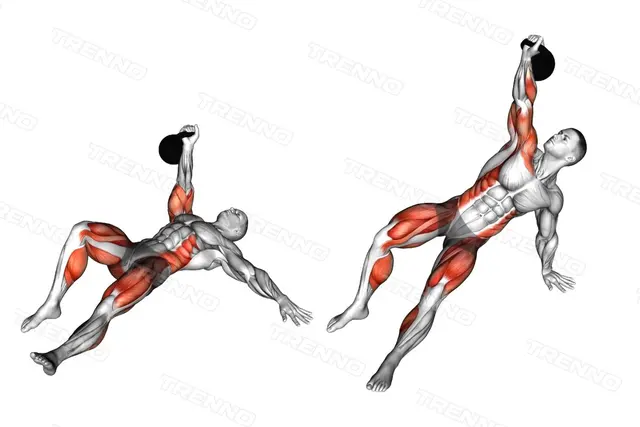
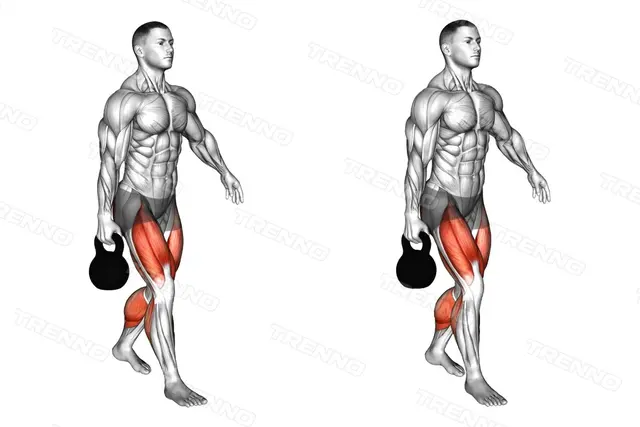
| Shoulders and trunk | Kettlebell Halo | Kettlebell Windmill | Kettlebell Turkish Get-Up, Kettlebell Suitcase Carry |
Rest on the days between. Every session trains the hips through a swing, a deadlift or a high pull, presses overhead or from the floor, and pulls; the legs get a lunge on Monday and a squat on Friday. That is 44 working sets a week, 14 or 15 a session. Most of the upper-body work is one arm at a time, which is how one bell trains both sides evenly.
Sets, reps, rest and effort
- Sets: 3 for most exercises, 4 for the swings, 2 for the halo and the windmill.
- Reps: 12 to 20 on the swings; 6 to 10 on the presses and the windmill; 8 to 12 on the rows, the floor press, the deadlift, the squat, the high pull and the halo; 10 to 16 on the lunge, counted over both legs; 5 to 8 on the clean and press; 3 to 5 on the get-up; the carry goes 40 meters.
- Rest: 1:30 after most sets, 1:00 after the halo, the windmill and the carry.
The one-arm exercises are done for each side: the program page counts 3 sets a side as 6 sets. In Trenno each side gets its own set, marked left and right.
Effort: end the sets with 1 to 3 clean reps in reserve. The get-up and the windmill are technique first: slow, every rep the same, and never to failure.
How to progress with a fixed weight
With the next bell a third heavier, adding weight every few weeks is not an option. Progress in this order:
- Reps, up to the top of the range on every set.
- The next bell for the first set only, even if it gives just 3 or 4 reps, with the other sets on the old one.
- One more set with the heavier bell each time its first set reaches the bottom of the range, until every set is on it.
The Kettlebell Overhead Press, 3 sets of 6 to 10 a side:
| Week | Bell | Reps a side, per set | Next week |
|---|---|---|---|
| 1 | 12 kg (about 26 lb) | 6, 6, 6 | same bell |
| 2 | 12 kg | 7, 7, 6 | same bell |
| 3 | 12 kg | 8, 8, 7 | same bell |
| 4 | 12 kg | 10, 9, 9 | same bell |
| 5 | 12 kg | 10, 10, 10 | first set on 16 kg |
| 6 | 16 kg, then 12 kg | 4; then 10, 10 | same |
It is the same idea as our progressive overload guide, stretched over the gap between two bells.
The next kettlebell programs
The cards under the plan are the next steps, each 8 weeks long:
| Program | Days a week | Bells | What it trains |
|---|---|---|---|
| One-Kettlebell Press, 3 days | 3 | One | The clean and press three times a week, in 5, 3 and 4 sets, with swings, snatches, the windmill and a carry |
| Kettlebell Conditioning, 3 days | 3 | One | A four-exercise circuit, a snatch day and a day of eight sets of swings |
| Double Kettlebell Strength, 2 days | 2 | A pair | Front squats, deadlifts, presses and rows with two bells |
A lighter entry is Daily Swing and Get-Up: five days a week for 4 weeks, 100 one-arm swings and 10 get-ups a day. Explore also has single kettlebell routines for days off the program: “One-Kettlebell Full-Body”, “Kettlebell Quick Circuit”, “Kettlebell Strength” and “Kettlebell Core and Carry”.
What the research says
Kettlebell research is thinner than barbell research, but it points one way:
- Swings built strength and jump height. In 21 men, six weeks of twice-weekly swing sessions, 12 rounds of 30 seconds on and 30 off, raised the half-squat one-rep maximum by 9.8 percent and the vertical jump by 19.8 percent, as much as jump-squat training (Lake and Lauder, 2012).
- The gains carried over. Ten weeks of kettlebell training twice a week improved bench press strength in adults aged 18 to 72 (Manocchia and colleagues, 2013).
- A barbell still wins at the heaviest lifts. In 30 men, weightlifting raised squat strength more than kettlebell training over 6 weeks (Otto and colleagues, 2012).
- The evidence is modest. A scoping review of 99 publications found few long-term studies, most of them small and of low quality, with effects that were typically trivial to small (Meigh and colleagues, 2019).
How long a session takes
Counted at about 40 seconds a working set, each side of a one-arm set, the rest the plan prescribes after each set and 5 minutes to set up, each session takes about 40 minutes. Add 5 to 10 minutes of warm-up: a few light swings and a slow get-up.
Common mistakes
- Squatting the swing. Bending the knees deep to lift the bell turns a hip exercise into a squat. The drive comes from the hips; the arms are along for the ride.
- One bell for everything for too long. The presses decide the first bell; the swings usually outgrow it first.
- Rushing the get-up. A fast get-up skips the positions that make it worth doing.
- Jumping to the next bell for every set at once. Move one set at a time.
FAQ
Can you build muscle with kettlebells?
Yes, when the sets are hard. Muscle grows across a wide range of loads when sets end close to failure (Schoenfeld and colleagues, 2017); the limit is how heavy your heaviest bell is.
What weight kettlebell should I start with?
The heaviest bell you can press overhead with one arm for about six clean reps. For the swings, the same bell until it feels light.
One bell or two?
One to start. A heavier second bell for the swings and the deadlifts is the first upgrade; a matched pair opens the double program.
Can I train with kettlebells every day?
Not with this plan: it is written for three days with a rest day between them. Daily Swing and Get-Up is built for five days a week: two exercises, 10 sets.
Sources
- Lake JP, Lauder MA. Kettlebell swing training improves maximal and explosive strength. Journal of Strength and Conditioning Research, 2012.
- Manocchia P, Spierer DK, Lufkin AK, Minichiello J, Castro J. Transference of kettlebell training to strength, power, and endurance. Journal of Strength and Conditioning Research, 2013.
- Otto WH, Coburn JW, Brown LE, Spiering BA. Effects of weightlifting vs. kettlebell training on vertical jump, strength, and body composition. Journal of Strength and Conditioning Research, 2012.
- Meigh NJ, Keogh JWL, Schram B, Hing WA. Kettlebell training in clinical practice: a scoping review. BMC Sports Science, Medicine and Rehabilitation, 2019.
- Schoenfeld BJ, Grgic J, Ogborn D, Krieger JW. Strength and hypertrophy adaptations between low- vs. high-load resistance training: a systematic review and meta-analysis. Journal of Strength and Conditioning Research, 2017.
All five programs are in Trenno’s Explore with their days, sets and rest times. The previous session’s sets show beside the empty ones, and the rest timer starts when you tick a set.