
Who this plan is for
Suspension straps hang from a door, a bar or a beam, and your body is the weight. The program above is written for intermediate lifters who have trained for a few months and want a full plan they can run at home or take on the road: three days a week for 8 weeks, every exercise on the straps.
Straps are a real training tool, not a travel compromise. In a 12-week study, 42 untrained older adults did three sets of whole-body exercises to failure, either on suspension straps or with conventional resistance training: muscle thickness and strength rose by similar amounts in both groups (Soligon and colleagues, 2020).
Pick something else if:
- You are new to the straps. Run the “Suspension Beginner” routine from Explore for two weeks first: five basic exercises, two sets each, every one at its easiest angle.
- Your legs are the priority. The program gives them 9 sets a week. The glute workout plan gives the lower body three days of its own.
How the angle sets the load
On the straps you never add a plate. You change how much of your body the straps hold, and that depends on the angle of your body. In a study of 28 men doing push-ups on straps at four angles, load cells in the straps showed that the lower the angle, the more of the body weight the straps held: at the lowest, about half of it with the arms straight and three quarters at the bottom of the push-up (Gulmez, 2017).
| Exercises | Easier | Harder |
|---|---|---|
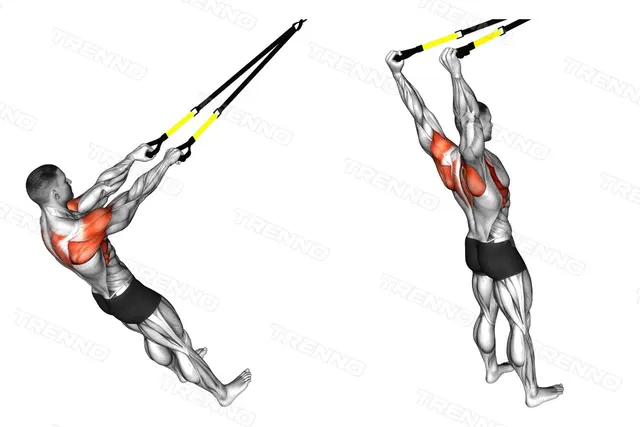
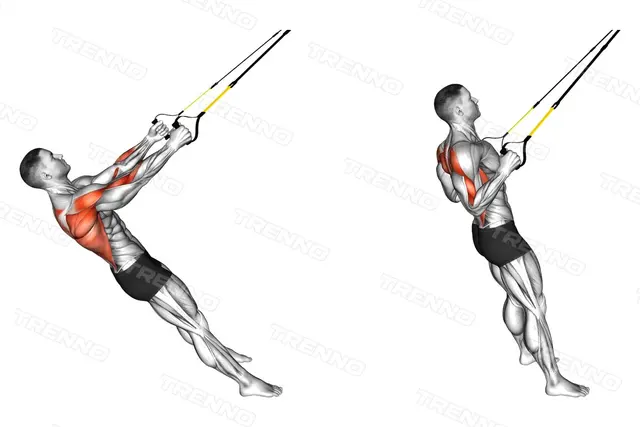
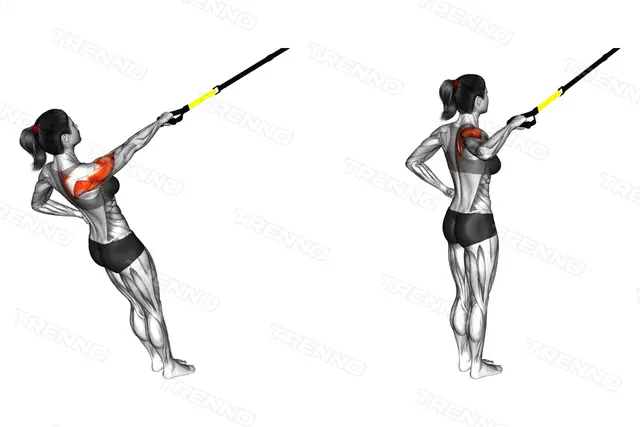
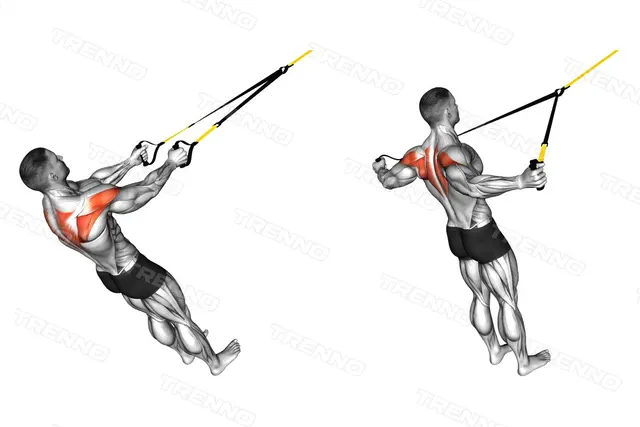
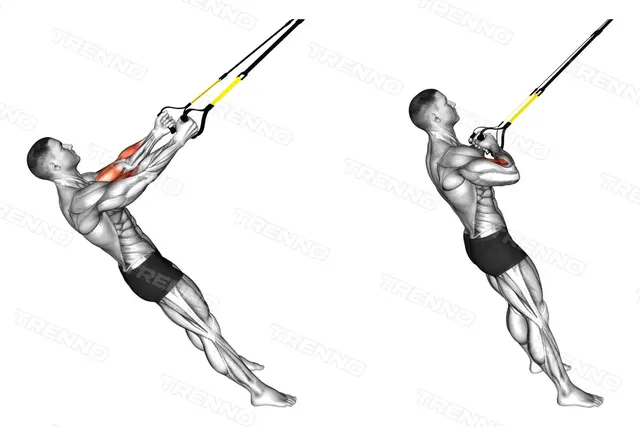
| TRX Row, TRX Biceps Curl, TRX Reverse Fly, TRX Y Fly: you face the anchor and lean back | Body more upright | Body closer to horizontal |
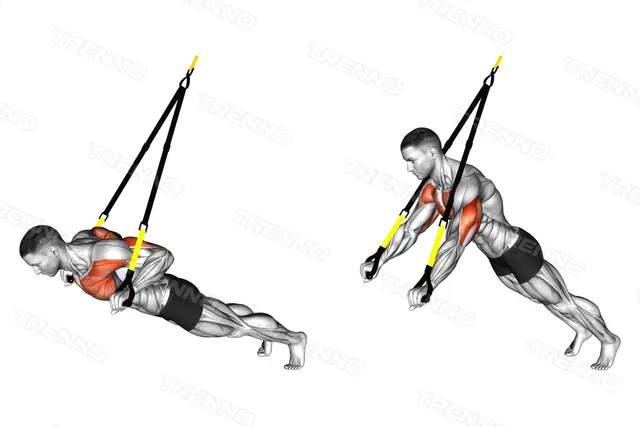
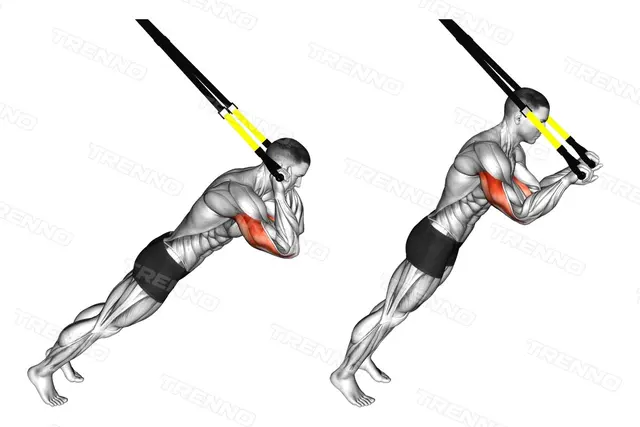
| TRX Chest Press, TRX Triceps Extension: you face away and lean forward | Body more upright | Body closer to horizontal |
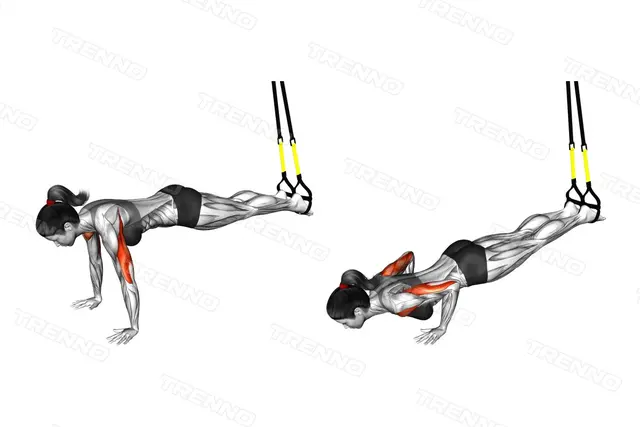
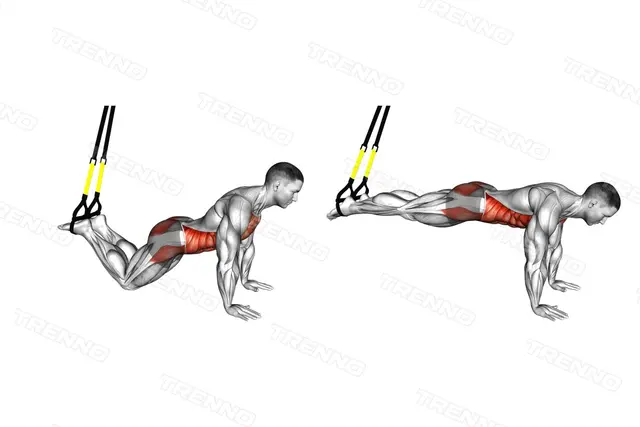
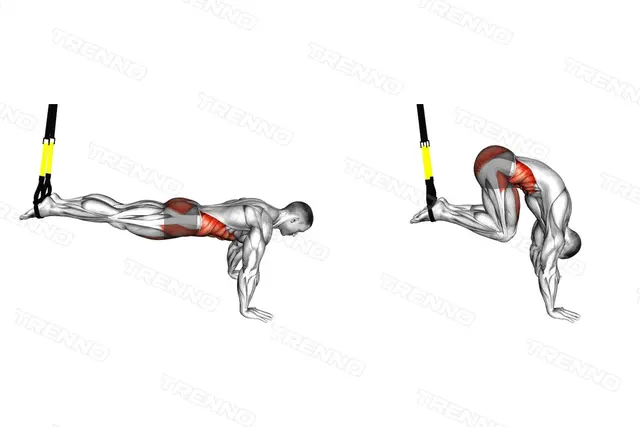
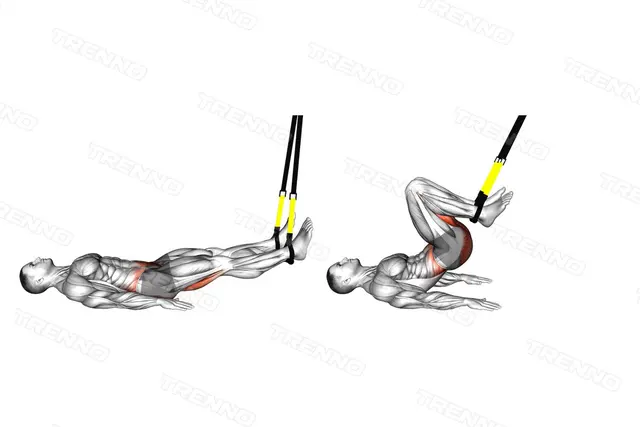
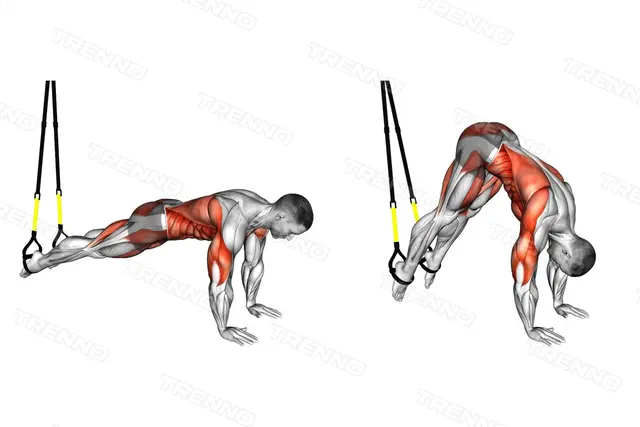
| TRX Push-Up, TRX Pike, TRX Jackknife: feet in the straps | Hands on a bench, knees tucked | Hands on the floor, legs straight |
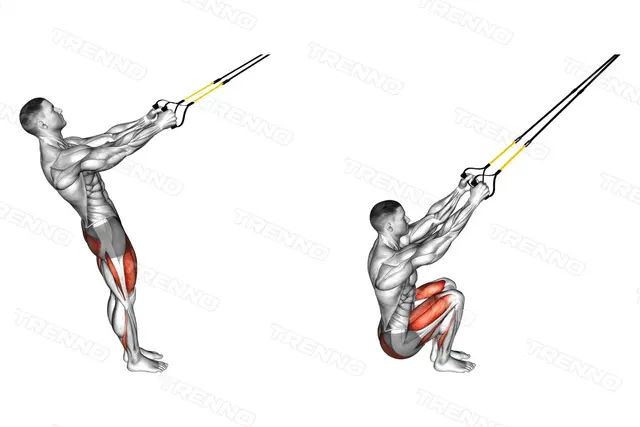
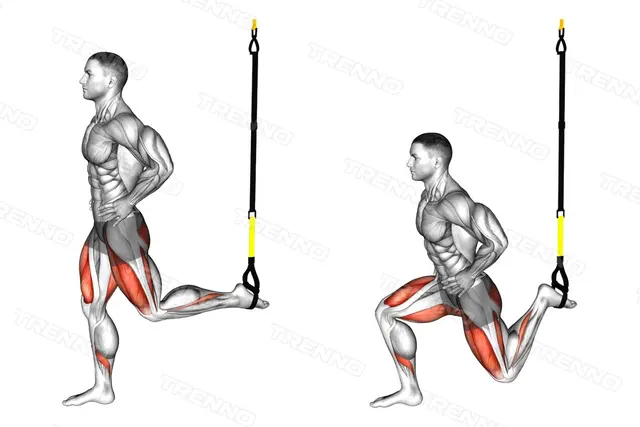
| TRX Squat, TRX Split Squat | More help from the handles | Less help, a slower way down |
Move your feet a step and the angle changes. That step is the whole progression, so make it repeatable: note where you stood, in foot lengths from the anchor or by a line on the floor.
How the week works
| Monday | Wednesday | Friday | |
|---|---|---|---|
| Day | Full Body A: pressing | Full Body B: pulling | Full Body C: legs and core |
| First | TRX Chest Press, TRX Push-Up | TRX Row, TRX Single-Arm Row | TRX Squat, TRX Split Squat |
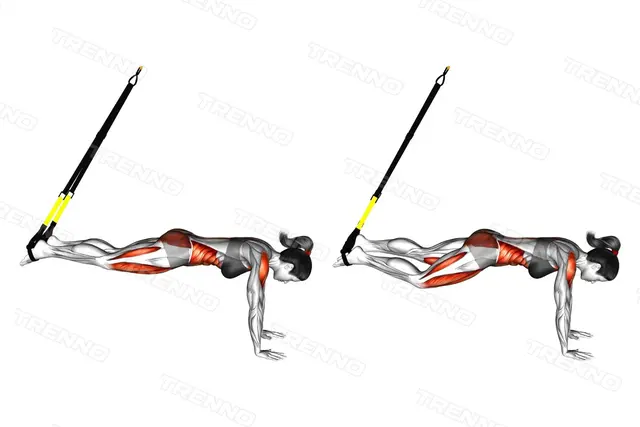
| Then | TRX Y Fly, TRX Triceps Extension, TRX Plank | TRX Reverse Fly, TRX Biceps Curl, TRX Jackknife | TRX Hamstring Curl, TRX Pike, TRX Mountain Climber |
Rest on the days between. Counted from the rows, by the body part each exercise is filed under in our exercise library, a one-sided row counted once, the week gives:
| Body part | Sets a week |
|---|---|
| Abs | 12 |
| Back | 9 |
| Chest | 6 |
| Quadriceps | 6 |
| Triceps, biceps, shoulders, hamstrings | 3 each |
That is 45 sets, 15 a day. The upper body and the trunk get the most; a squat on straps is hard to make much heavier, which is why the legs get less. For more leg work, add the “Suspension Lower Body” routine on a fourth day.
Sets, reps, rest and effort
- Sets: 3 of everything.
- Reps: 10 to 15 for most exercises, 8 to 12 for the push-up, the pike and the two one-sided exercises, 12 to 15 for the squat; the plank holds 40 seconds and the mountain climber runs 30.
- Rest: 1:30 after the first two exercises of each day, 1:00 after the rest.
- Effort: end each set with one or two clean reps left, and keep the body in one line; a sagging hip means the set is over.
The TRX Single-Arm Row and the TRX Split Squat are done for each side, 3 sets a side; the program’s page counts them as 6 sets. Push-ups on straps are harder than they look: in a comparison of 21 adults, a suspension push-up drew more activity from the chest, the front shoulders and the triceps than a floor push-up (Snarr and Esco, 2013).
How to progress
Use double progression, as in our progressive overload guide, with the angle in place of the weight: when every set reaches the top of its range, move a step lower. An example on the TRX Row, 3 sets of 10 to 15:
| Week | Angle | Reps per set | Next session |
|---|---|---|---|
| 1 | Starting angle | 12, 11, 10 | same |
| 2 | Starting angle | 14, 13, 12 | same |
| 3 | Starting angle | 15, 15, 14 | same |
| 4 | Starting angle | 15, 15, 15 | a step lower |
| 5 | A step lower | 12, 11, 11 | same |
| 6 | A step lower | 14, 13, 12 | same |
A step lower means your feet move so that the body sits closer to horizontal. When the lowest angle is easy, change the exercise, not the angle: the TRX Single-Arm Row after the two-handed row, the TRX Pike after the TRX Jackknife. Slowing the way down to three seconds is the last step before that.
The shorter strap routines in Explore
The program is not the only strap work in Trenno. Explore has seven single routines for days outside it, among them:
| Routine | Sets | Minutes |
|---|---|---|
| Suspension Beginner | 10: five exercises, two sets each | about 20 |
| Suspension Quick Session | 18, as three supersets | about 23 |
| Suspension Core | 10: five exercises, twice round | about 12 |
| Suspension Lower Body | 15 | about 30 |
“Suspension Trainer Upper Body”, “Suspension Trainer Full-Body” and “Home Straps + Dumbbells”, where a pair of dumbbells loads the squat, the hinge and the press while the straps take the pulls and the core, complete the set.
Substitutions
| If | Instead of | Do |
|---|---|---|
| The straps are not set up yet but a sturdy table is there | TRX Row | Inverted Row |
| The push-up with the feet in the straps is too hard | TRX Push-Up | The same push-up with the hands on a bench |
| The pike is too hard | TRX Pike | TRX Jackknife |
Keep the sets, the reps and the rest of the row you replace.
How long a session takes
Counted at about 40 seconds a set, each side of a one-sided set, the holds as written and the rest the plan prescribes after every set: Monday’s session takes about 28 minutes, Wednesday’s and Friday’s about 30. Add a few minutes to change the strap length between exercises: the plank wants the straps a hand’s width above the floor, the chest press wants the straps at mid-length.
Common mistakes
- Letting the hips sag in the planks, the push-ups and the rows. The line from head to heels is part of every rep.
- Changing the angle in the middle of a set to squeeze out reps. Finish the set where you started it.
- Leaving the straps slack. They stay taut from the first rep to the last.
- Forgetting where you stood. Without it, next week’s step lower is a guess.
FAQ
Can you build muscle with a suspension trainer?
Yes. Muscle and strength rose as much on straps as with conventional training in the study of older adults above. The limit is the legs, which the straps load less than the upper body.
How many days a week should I train on straps?
Three, as the program runs, with a day between. The Core and Quick Session routines fit on the days between if you want more.
Do I need a TRX?
Any suspension straps with handles and foot cradles will do. The hamstring curl, the pike and the jackknife need the cradles.
Where can I anchor the straps at home?
A door anchor on a closed door, a sturdy bar or a beam that can hold your weight. Test it with a firm pull before the first set.
Is it good for beginners?
The program is intermediate. Beginners start with “Suspension Beginner” and its easiest angles, then move on.
Sources
- Gulmez I. Effects of angle variations in suspension push-up exercise. Journal of Strength and Conditioning Research, 2017.
- Soligon SD and colleagues. Suspension training vs. traditional resistance training: effects on muscle mass, strength and functional performance in older adults. European Journal of Applied Physiology, 2020.
- Snarr RL, Esco MR. Electromyographic comparison of traditional and suspension push-ups. Journal of Human Kinetics, 2013.
The program and every strap routine are in Trenno’s Explore. The one-sided exercises get a set for each side, marked left and right, and the previous session’s reps show beside the empty ones. Write where you stood in the exercise’s note, and next week starts from there.