
Who this plan is for
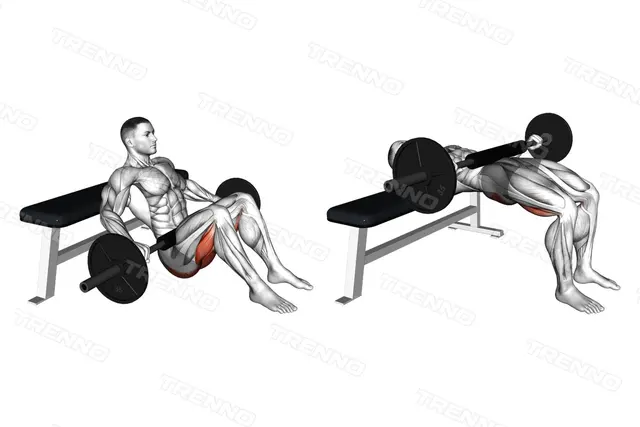
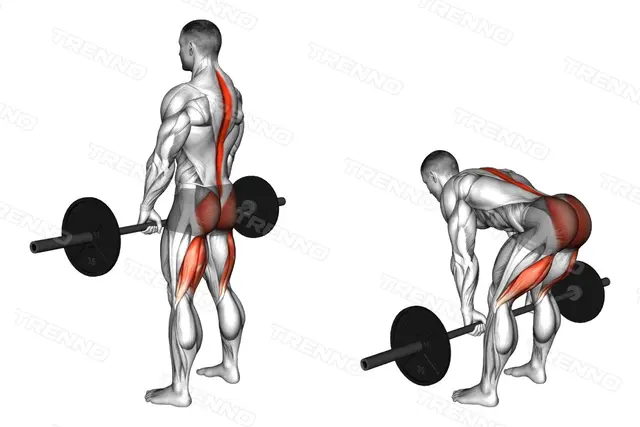
The glutes are the biggest muscles of the hips, and they grow the way every muscle does: from hard sets, enough of them each week, with loads that go up over time. The plan above gives them three lower-body days a week, one built around the Barbell Hip Thrust, one around the Barbell Back Squat and one around the Deadlift. It is written for intermediate lifters, about six months of consistent training or more, who already squat and hinge with control. Our library lists the exercises for this group under Glutes.
Pick another plan if:
- You are in your first months of lifting. Squats, lunges and hinges already train the glutes, and a beginner plan has all three: start with the 3-day full-body plan.
- You want the whole body trained evenly. The upper/lower split gives the legs two days out of four.
How the week works
The program is lower body only. To train the upper body as well, add the two upper days of Intermediate Upper/Lower, 4 days, which is also in Trenno’s Explore:
| Day | Session | Opens with |
|---|---|---|
| Monday | Glute Focus | Barbell Hip Thrust |
| Tuesday | Upper Body: Bench Press, optional | Barbell Bench Press |
| Wednesday | Quad Focus | Barbell Back Squat |
| Thursday | Rest | |
| Friday | Posterior Chain | Deadlift |
| Saturday | Upper Body: Overhead Press, optional | Seated Barbell Overhead Press |
| Sunday | Rest |
The three lower days never sit next to each other, and the squat and the deadlift, the two heaviest sessions, have a rest day between them. Counted by the body part each exercise is filed under in our exercise library, with a one-sided exercise counted once, as each side gets its sets:
| Body part | Sets a week | Days |
|---|---|---|
| Glutes | 22 | Monday 13, Friday 9 |
| Quadriceps | 13 | Wednesday |
| Hamstrings | 9 | Monday, Friday |
| Calves | 4 | Wednesday |
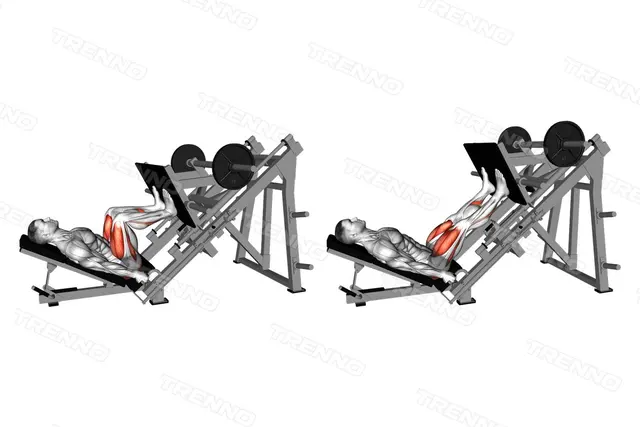
The glutes do more than their own row. The squat, the Leg Press, the Bulgarian Split Squat and the Romanian Deadlift also list them among their main muscles, and counting those, the glutes work in 35 sets a week, on all three days.
What grows the glutes
No single exercise does, and the research on the two favorites says why:
- The hip thrust and the squat grew the glutes about equally. In a 9-week study of untrained adults with the same number of sets, both groups gained similar glute size on MRI; the squat also grew the thighs more. The hip thrust made the glutes more active in the first session, but that did not predict who grew more (Plotkin and colleagues, 2023).
- In trained women, the squat did better. Over 12 weeks, the squat group added more glute thickness than the hip thrust group, 9.4 against 3.7 percent (Barbalho and colleagues, 2020).
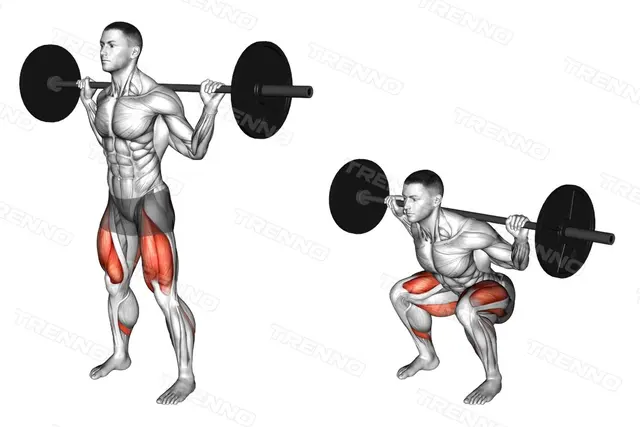
- Depth matters. Full squats grew the glutes by 6.7 percent in 10 weeks, half squats by 2.2 (Kubo and colleagues, 2019).
- So do the weekly sets. A meta-analysis of 15 studies found a graded dose-response: more weekly sets, more growth (Schoenfeld and colleagues, 2017).
That is the plan: deep squats, hip thrusts and hinges, each with a day of its own. Its 22 weekly sets filed under the glutes are the most of any program in Trenno; the next is the bodyweight beginner plan, with 15.
Sets, reps, rest and effort
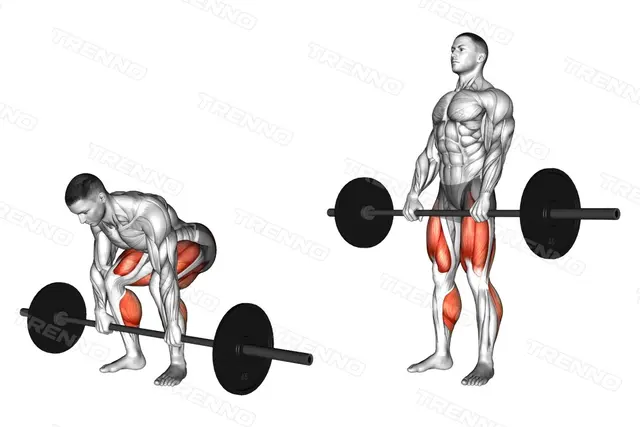
- The first lift of each day is the heavy one: the Barbell Hip Thrust for 4 sets of 8 to 12 after one warm-up set, the squat for 4 sets of 6 to 10 after two, the deadlift for 3 sets of 5 to 8 after two. They rest 2:30, the deadlift 3:00.
- The middle of the day: 3 sets of 8 to 12, 10 to 15 or 12 to 15, with 1:30 of rest.
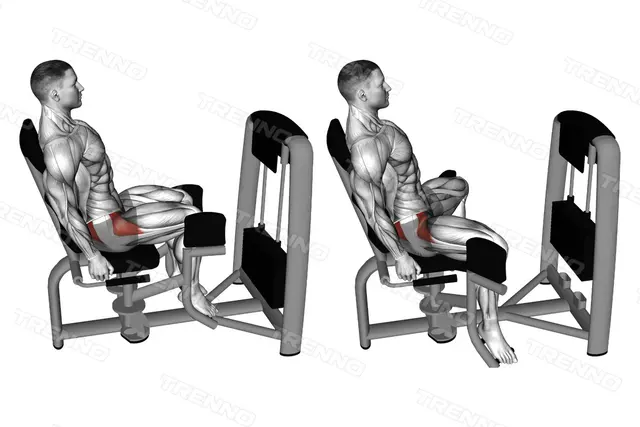
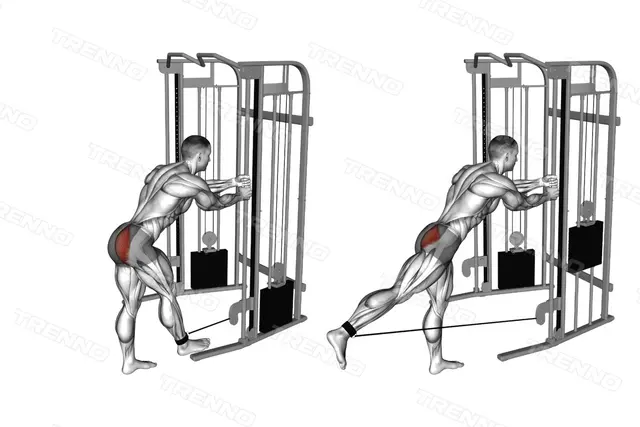
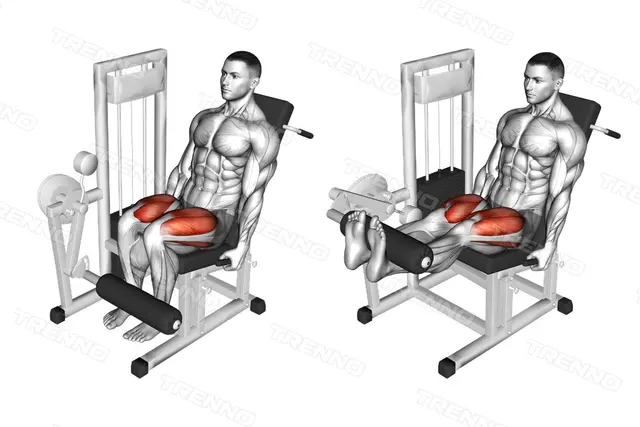
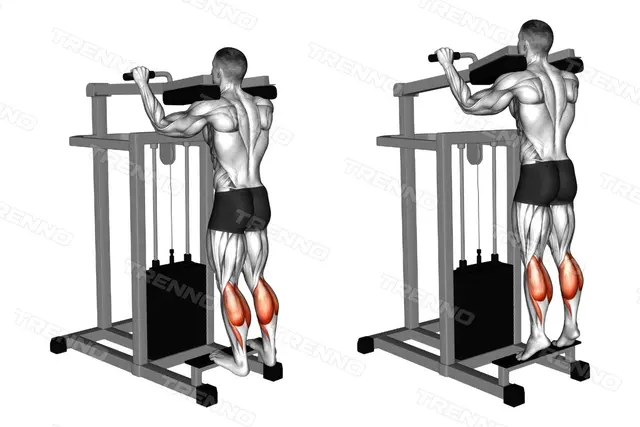
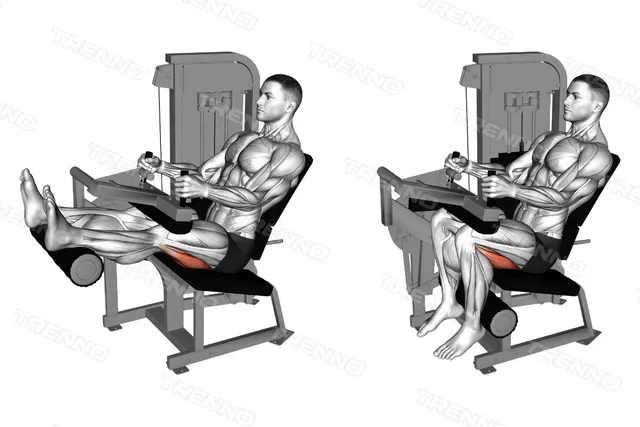
- The small exercises: the Hip Abduction for 15 to 20 reps, the Leg Extension, the Seated Leg Curl and the Cable Glute Kickback for 10 to 15 or 12 to 15, and the Standing Calf Raise for 4 sets of 10 to 15, all with a minute of rest.
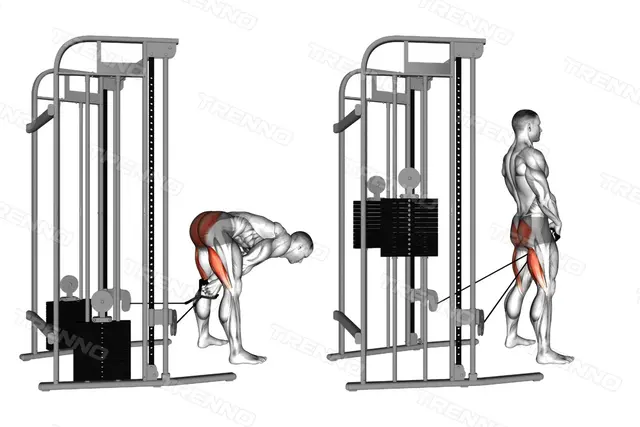
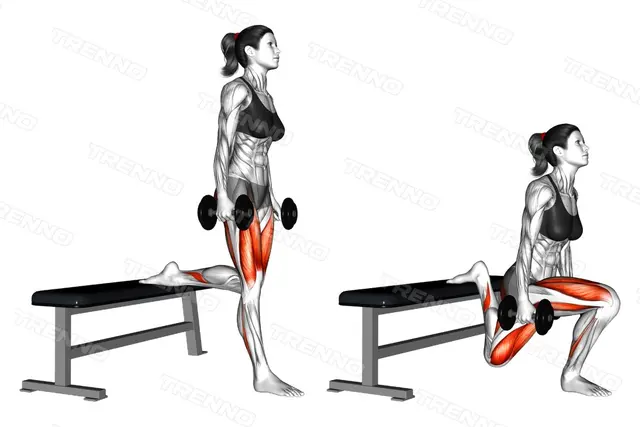
The kickback and the Bulgarian split squat are one-sided: 3 sets for each leg, which the program page counts as 6. In Trenno a one-sided exercise like the kickback gets a set for each side, marked left and right.
End the heavy sets with 1 to 3 reps in reserve and the small exercises with 0 to 2. Going to failure is not required; a meta-analysis of 15 studies found no advantage in growth for sets taken to momentary failure (Refalo and colleagues, 2023).
How to progress
Use double progression, as in our progressive overload guide: keep the weight until every set reaches the top of the range, then add the smallest step. The Barbell Hip Thrust on Monday, 4 sets of 8 to 12:
| Week | Weight | Reps per set | Next week |
|---|---|---|---|
| 1 | 60 kg (about 130 lb) | 10, 9, 9, 8 | same weight |
| 2 | 60 kg | 11, 10, 10, 9 | same weight |
| 3 | 60 kg | 12, 11, 11, 10 | same weight |
| 4 | 60 kg | 12, 12, 12, 12 | add 2.5 kg |
| 5 | 62.5 kg | 10, 10, 9, 9 | same weight |
| 6 | 62.5 kg | 11, 11, 10, 10 | same weight |
As the weight climbs, a thick pad around the bar is part of the hip thrust’s setup, not a luxury.
Substitutions
| Instead of | If | Do |
|---|---|---|
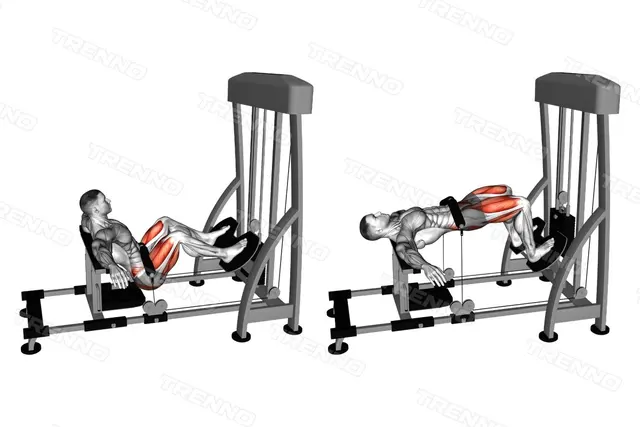
| Barbell Hip Thrust | The bench or the bar is busy | Machine Hip Thrust |
| Barbell Back Squat | No rack is free | Hack Squat |
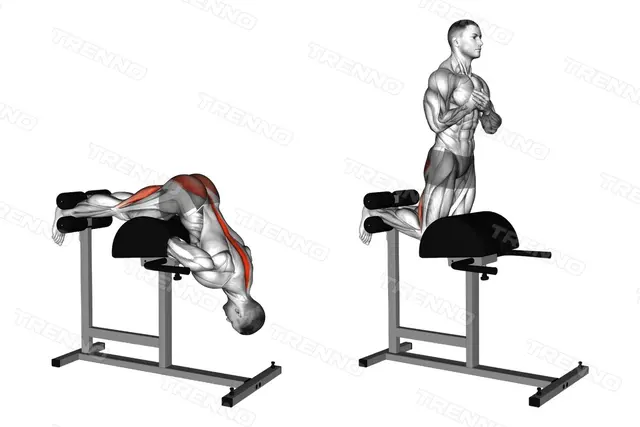
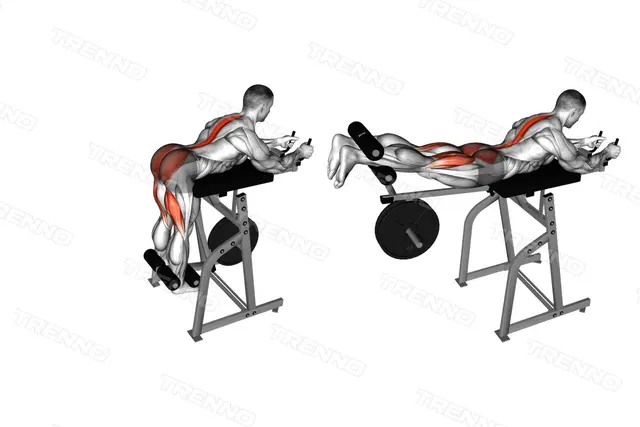
| Glute-Ham Raise | There is no glute-ham bench | Nordic Hamstring Curl |
| Reverse Hyperextension | There is no machine | Back Extension |
| Hip Abduction | There is no machine | Cable Hip Abduction |
| Cable Glute Kickback | The cables are busy | Single-Leg Glute Bridge |
| Cable Pull-Through | The cables are busy | Dumbbell Romanian Deadlift |
Keep the sets, the reps and the rest of the exercise you replace.
One glute session in Trenno
If you follow another plan and want one extra glute day instead of three, Explore in Trenno has a single routine for it, “Glutes and Hamstrings”: the Barbell Hip Thrust, the Romanian Deadlift, the Seated Leg Curl, the kickback and the abduction machine, 16 sets in all.
How long a session takes
Counted at about 40 seconds a working set, each side of a one-sided set, the rest the plan prescribes after each set, a minute per warm-up set and 5 minutes to set up and move between stations: Glute Focus takes about 44 minutes, Quad Focus about 46 and Posterior Chain about 43. The two upper days add about 56 and 58.
Common mistakes
- Only the small exercises. Kickbacks and abductions have their place, but the three lifts that open the days are where the weight climbs week after week.
- Half squats. The full range built more glute in the depth study above; go as deep as you can with a flat back.
- Finishing the hip thrust with the lower back. Lock out by squeezing the hips, not by arching.
- Squat day straight after deadlift day. Keep the rest day between them.
- A fourth glute day. 35 sets a week that work the glutes are plenty to recover from.
FAQ
How long does it take to grow your glutes?
There is no fixed answer. In the studies above, glute growth showed on scans after 9 to 12 weeks of training, and the program runs 12.
Hip thrust or squat: which is better for the glutes?
Both work, and the evidence is split: equal growth in untrained adults, more for the squat in trained women. The plan does both, each on its own day.
Can I train the glutes every day?
Not hard. Our muscle recovery guide puts the gap after a hard session at two to three days, and lists the signs to watch.
Do I need the hip abduction machine?
It is the one exercise in the plan whose main job is the side of the hips, the gluteus medius. Keep it, or use the cable version when the machine is busy.
Sources
- Plotkin DL and colleagues. Hip thrust and back squat training elicit similar gluteus muscle hypertrophy and transfer similarly to the deadlift. Frontiers in Physiology, 2023.
- Barbalho M, Coswig V, Souza D, Serrão JC, Hebling Campos M, Gentil P. Back squat vs. hip thrust resistance-training programs in well-trained women. International Journal of Sports Medicine, 2020.
- Kubo K, Ikebukuro T, Yata H. Effects of squat training with different depths on lower limb muscle volumes. European Journal of Applied Physiology, 2019.
- Schoenfeld BJ, Ogborn D, Krieger JW. Dose-response relationship between weekly resistance training volume and increases in muscle mass: a systematic review and meta-analysis. Journal of Sports Sciences, 2017.
- Refalo MC, Helms ER, Trexler ET, Hamilton DL, Fyfe JJ. Influence of resistance training proximity-to-failure on skeletal muscle hypertrophy. Sports Medicine, 2023.
The program is in Trenno’s Explore with its three days, their sets and their rest times. The previous session’s sets show beside the empty ones, so each week’s hip thrust starts from last week’s numbers, and the rest timer starts when you tick a set.