

Who this plan is for
Push pull legs (PPL) groups the week by movement: one day for everything that pushes (chest, shoulders, triceps), one for everything that pulls (back, rear shoulders, biceps), one for the legs. The three-day plan above is written for intermediate lifters: about six months of consistent training, as the American College of Sports Medicine puts it, and a squat, a bench press and a row that look the same from the first rep to the last. The six-day version, Advanced Push Pull Legs, runs the same idea twice a week for lifters with years behind them and the time to train most days.
Pick something else if:
- You are in your first months of lifting. Three full-body days let you practice the main movements several times a week. Start with the 3-day full-body plan and come back after it.
- Two days a week is all you have. Push pull legs needs three sessions to cover the body once; two full-body days cover it twice.
How the push pull legs week works
| Day | 3 days | 6 days | Rolling, week 1 | Rolling, week 2 |
|---|---|---|---|---|
| Monday | Push | Push A | Push A | Rest |
| Tuesday | Rest | Pull A | Pull A | Push A |
| Wednesday | Pull | Legs A | Legs A | Pull A |
| Thursday | Rest | Push B | Rest | Legs A |
| Friday | Legs | Pull B | Push B | Rest |
| Saturday | Rest | Legs B | Pull B | Push B |
| Sunday | Rest | Rest | Legs B | Pull B |
The rolling version runs the six days of the advanced plan in order with a rest day after every third session. The cycle takes eight days, so a calendar week holds five or six sessions and the rest days move. Choose it when six days in a row are too many and fixed weekdays do not matter to you.
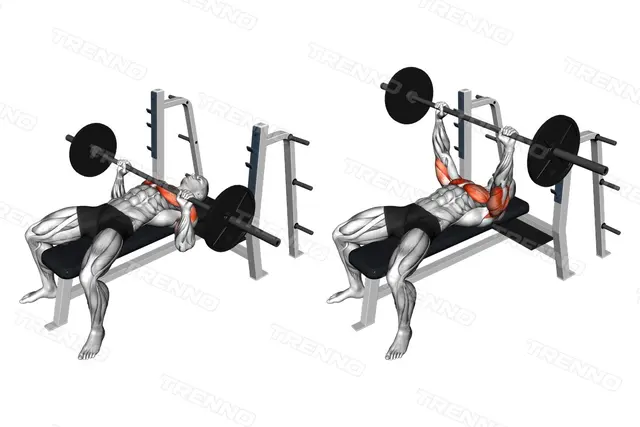
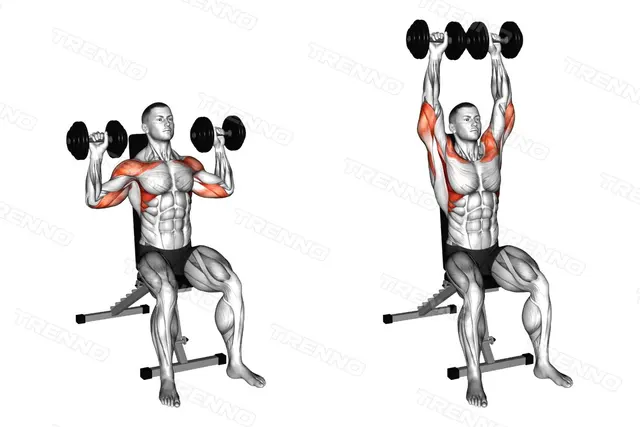
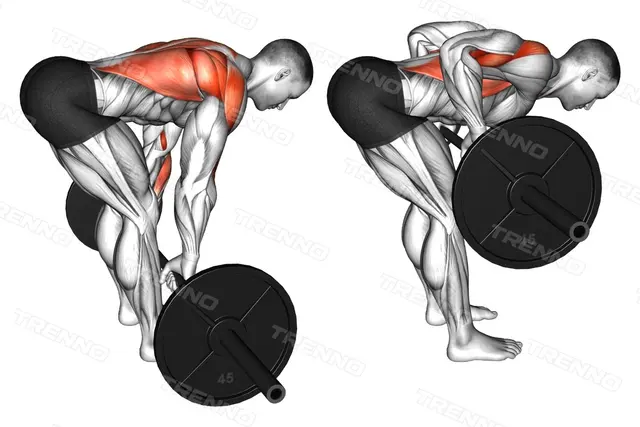
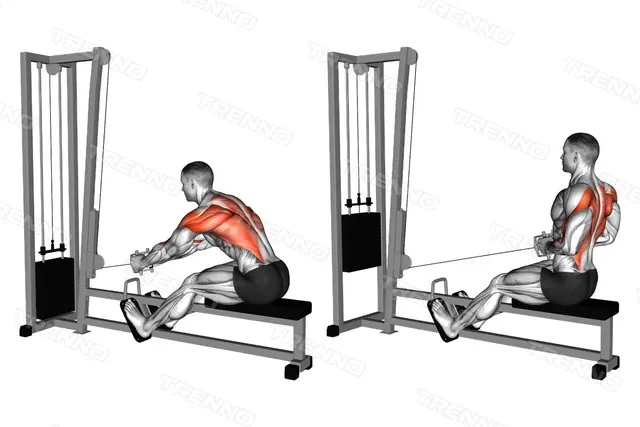
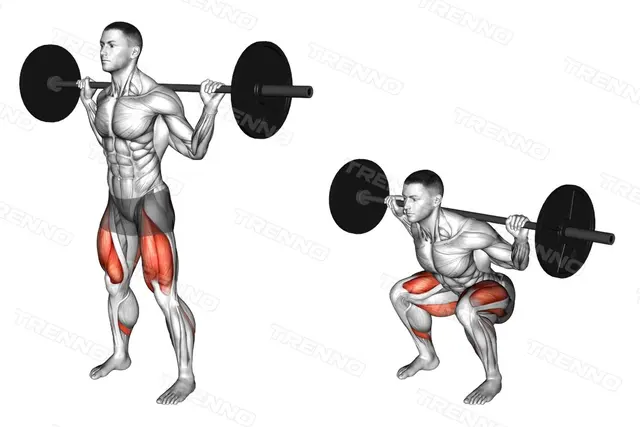
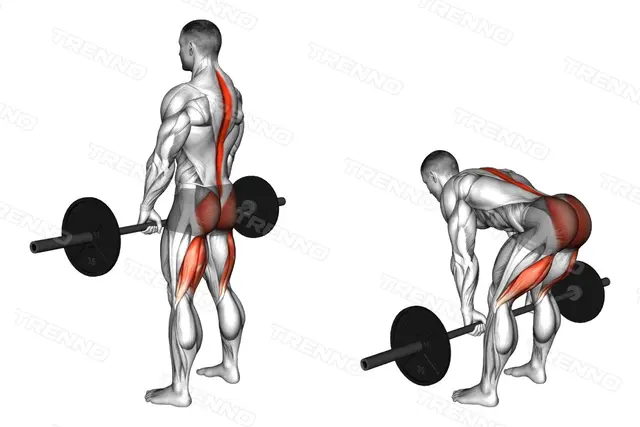
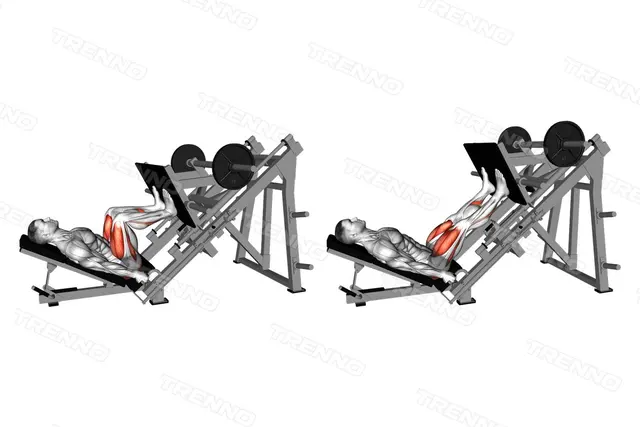
Push and pull days use different muscles, so they can sit on neighboring days. In the six-day plan the A days open with the Barbell Bench Press, the Pull-Up and the Barbell Back Squat, the B days with the Seated Barbell Overhead Press, the Deadlift and the Hack Squat. Every heavy lift is trained hard once a week, and every muscle gets two days.
That doubles the weekly work. Counted by the body part each exercise is filed under in our exercise library, the two plans give:
| Body part | Sets a week, 3 days | Sets a week, 6 days |
|---|---|---|
| Chest | 7 | 16 |
| Back | 10 | 17 |
| Shoulders | 9 | 19 |
| Quadriceps | 7 | 17 |
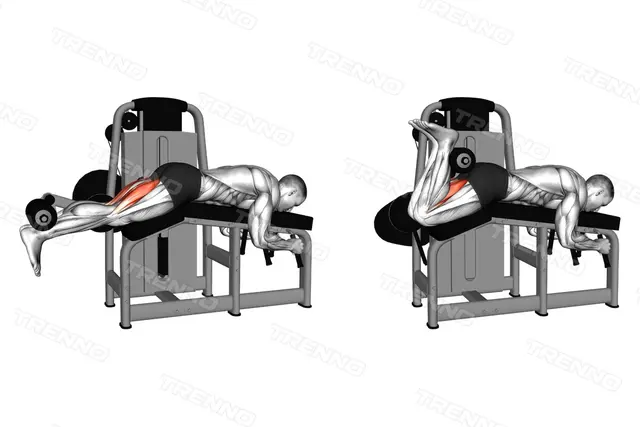
| Hamstrings | 6 | 9 |
| Biceps | 5 | 9 |
| Triceps | 5 | 9 |
| Calves | 4 | 8 |
Research is clearer on the sets than on the days. A meta-analysis of 15 studies found a graded dose-response: more weekly sets, more growth (Schoenfeld and colleagues, 2017). An earlier review found that, with the same weekly sets, training a muscle twice a week grew more than once (2016); a larger one of 25 studies found no real difference (2019). So the three-day plan works, and the six-day plan works better mainly because it does more.
Sets, reps, rest and effort
- The first lift of every day is the heavy one: 4 sets of 6 to 10 reps after 2 warm-up sets, with 2:30 of rest.
- The next two exercises take 3 sets of 8 to 12 or 10 to 15, with 1:30 of rest.
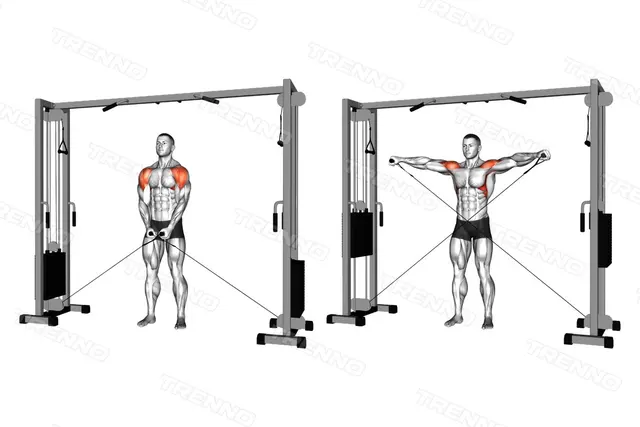
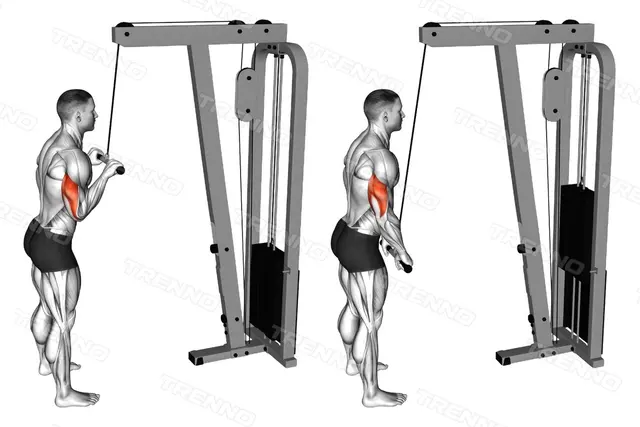
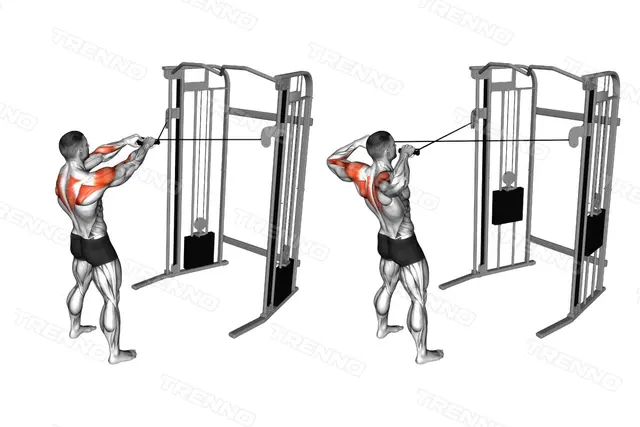
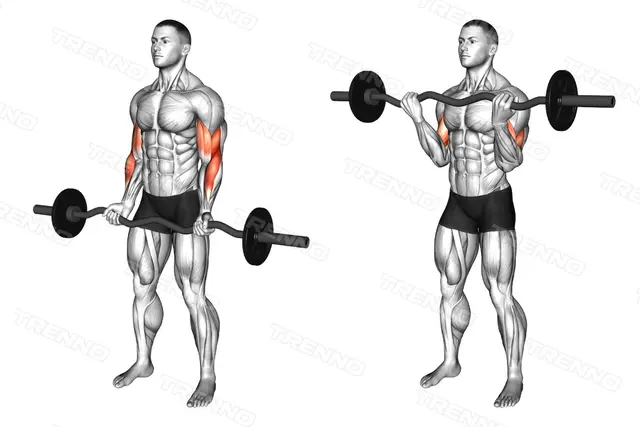
- The smaller muscles close the day with a minute of rest and wider ranges, up to 15 or 20 reps. Two of them run as a superset: the Cable Lateral Raise with the Cable Triceps Pushdown on push day, the Face Pull with the EZ-Bar Biceps Curl on pull day. How to run a superset is in our supersets guide.
The six-day plan keeps that structure with heavier ranges on the main lifts (6 to 8 reps on the bench press, the squat and the overhead press) and the Deadlift at 3 sets of 5 to 8, after 3 warm-up sets, with 3:00 of rest.
The long rest on the first lift is not a luxury. In an 8-week study of trained men, 3-minute rests produced more strength and more thigh muscle than 1-minute rests (Schoenfeld and colleagues, 2016).
Effort is counted in reps in reserve (RIR): how many more clean reps you could have done when you stopped. Aim for 1 to 3 in reserve on the heavy first lift and 0 to 2 on the last exercises. Going all the way to failure is not required for growth: a meta-analysis of 15 studies found no advantage for sets taken to momentary failure over sets stopped short of it (Refalo and colleagues, 2023).
How to progress
Use double progression, explained in full in our progressive overload guide: keep the weight until every set reaches the top of the range, then add the smallest step the gym has. On a barbell that is 2.5 kg, or 5 lb in a gym that loads pounds. An example on the Barbell Bench Press, 4 sets of 6 to 10:
| Week | Weight | Reps per set | Next session |
|---|---|---|---|
| 1 | 60 kg (about 130 lb) | 9, 8, 7, 6 | same weight |
| 2 | 60 kg | 10, 9, 8, 7 | same weight |
| 3 | 60 kg | 10, 10, 9, 8 | same weight |
| 4 | 60 kg | 10, 10, 10, 10 | add 2.5 kg |
| 5 | 62.5 kg | 8, 7, 7, 6 | same weight |
| 6 | 62.5 kg | 9, 8, 8, 7 | same weight |
The same rule runs every exercise. Cable and machine stacks jump in bigger steps, which is why the last exercises have wide ranges: fill the range before you move the pin.
When to move from 3 days to 6
The three-day plan is written for 12 weeks. Move up when both of these are true:
- You finished the 12 weeks, or most lifts have stalled for two or three weeks with nothing in the log to explain it: poor sleep, an illness, a hard week at work.
- You can give the gym six sessions of about 50 minutes every week for the next 12 weeks, and you recover well from the three you do now.
If only four days fit, a four-day upper/lower split is the step between the two: every muscle twice a week in four sessions.
Substitutions
| If | Instead of | Do |
|---|---|---|
| No squat rack is free | Barbell Back Squat | Leg Press, then Hack Squat |
| No bench is free | Barbell Bench Press | Dumbbell Floor Press |
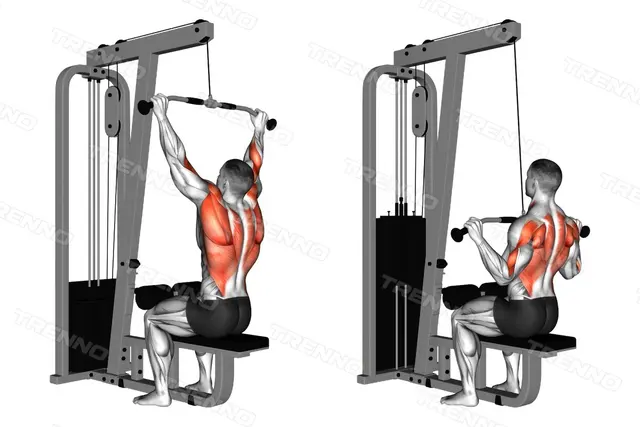
| You cannot do a pull-up yet | Pull-Up | Pull-Up (Assisted), or the Lat Pulldown |
| There is no cable station | Cable Lateral Raise | Dumbbell Lateral Raise |
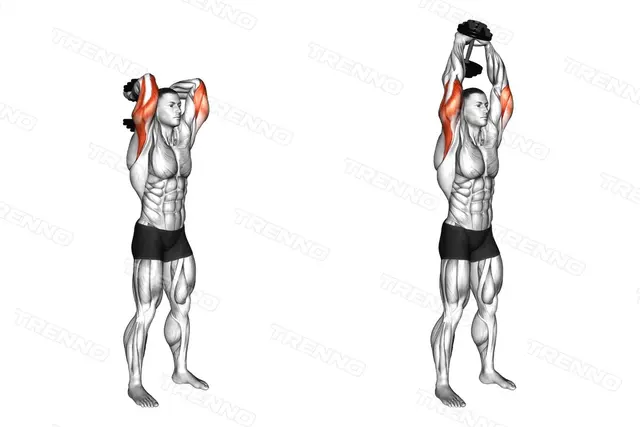
| There is no cable station | Cable Triceps Pushdown | Overhead Dumbbell Triceps Extension |
| There is no cable station | Face Pull | Dumbbell Rear Delt Fly |
| There is no EZ bar | EZ-Bar Biceps Curl | Barbell Biceps Curl |
Keep the sets, the reps and the rest of the row you replace.
How long a session takes
Counted at about 40 seconds a working set, the rest the plan prescribes after each set, a minute per warm-up set and 5 minutes to set up and move between stations: Push Day and Pull Day take about 45 minutes, Legs Day about 50. The six-day plan’s days take 45 to 50 minutes each. Add 5 to 10 minutes of easy warm-up before the first lift. That makes 2.5 to 3 hours a week on three days, and 5 to 6 hours on six.
Common mistakes
- Skipping legs day. In the three-day plan a missed Legs Day leaves the legs untrained for two weeks. Move it to the next free day instead.
- Adding exercises when a day feels short. Add weight or reps first. The plan already gives each muscle what it recovers from.
- Cutting the rest on the first lift to save a few minutes. It costs reps on every set after the first.
- Going to six days too early. Six days of half effort build less than three good ones.
FAQ
Is a 3-day push pull legs split enough to build muscle?
Yes, for an intermediate lifter who trains hard and adds weight or reps over the weeks. It gives each body part 4 to 10 hard sets a week. More weekly sets usually bring more growth, which is what the six-day version adds.
Should deadlifts go on pull day or legs day?
Either works. In the six-day plan the Deadlift opens Pull Day B and the Romanian Deadlift trains the hamstrings on both legs days; Pull Day B comes two days after the heavy squats. In the three-day plan the Romanian Deadlift covers the hinge on Legs Day.
What if I miss a day?
Do the missed day at the next session and keep the order. Do not squeeze two days into one.
Can beginners do push pull legs?
They can, but it is not where to start. The American College of Sports Medicine recommends 2 to 3 training days a week for novices, 3 to 4 for intermediate lifters and 4 to 5 for advanced ones, and a beginner learns the lifts faster by practicing each of them more than once a week.
Should I do cardio as well?
For your health, yes: the WHO recommends 150 to 300 minutes of moderate aerobic activity a week for adults, on top of muscle strengthening on 2 or more days. Put it on the rest days or after lifting, and keep it easy enough that the next session’s first lift does not suffer.
Sources
- Schoenfeld BJ, Ogborn D, Krieger JW. Dose-response relationship between weekly resistance training volume and increases in muscle mass: a systematic review and meta-analysis. Journal of Sports Sciences, 2017.
- Schoenfeld BJ, Ogborn D, Krieger JW. Effects of resistance training frequency on measures of muscle hypertrophy: a systematic review and meta-analysis. Sports Medicine, 2016.
- Schoenfeld BJ, Grgic J, Krieger J. How many times per week should a muscle be trained to maximize muscle hypertrophy? Journal of Sports Sciences, 2019.
- Schoenfeld BJ and colleagues. Longer interset rest periods enhance muscle strength and hypertrophy in resistance-trained men. Journal of Strength and Conditioning Research, 2016.
- Refalo MC, Helms ER, Trexler ET, Hamilton DL, Fyfe JJ. Influence of resistance training proximity-to-failure on skeletal muscle hypertrophy. Sports Medicine, 2023.
- American College of Sports Medicine. Progression models in resistance training for healthy adults. Medicine and Science in Sports and Exercise, 2009.
- Bull FC and colleagues. World Health Organization 2020 guidelines on physical activity and sedentary behaviour. British Journal of Sports Medicine, 2020.
Both programs are in Trenno’s Explore with their days, sets and rest times. The previous session’s sets show beside the empty ones, so the double progression decision takes a glance, and the rest timer starts when you tick a set.