

Who this plan is for
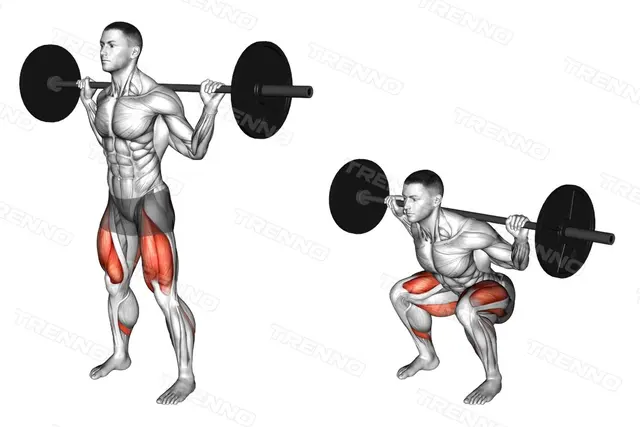
The plan above is for your first months with a barbell when the goal is strength: a heavier squat, bench press and deadlift. Every session opens with the Barbell Back Squat, the main lifts are done in sets of five, and the weight goes up whenever all the sets are complete. You need a squat rack, a bench, a barbell and plates small enough to add a little at a time.
Pick another plan if:
- Muscle size matters more to you than the numbers on the bar. The 3-day full-body plan trains more exercises in wider rep ranges.
- The barbell is new and you would rather start on machines. The machine workout plan builds the habit first.
- You have no rack. The dumbbell workout plan works with dumbbells and a chair.
How the week works
| Day | Session | Main lifts, sets of five | Then |
|---|---|---|---|
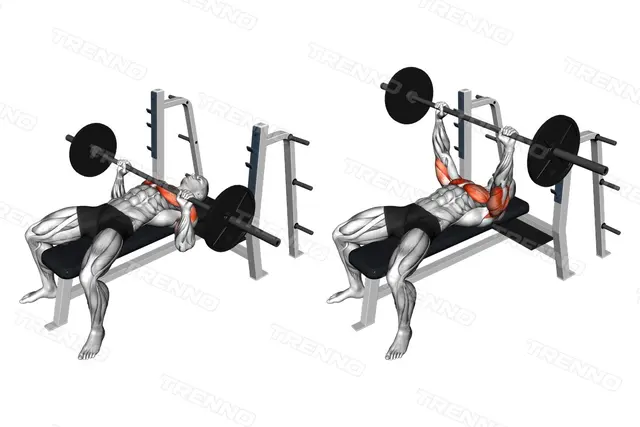
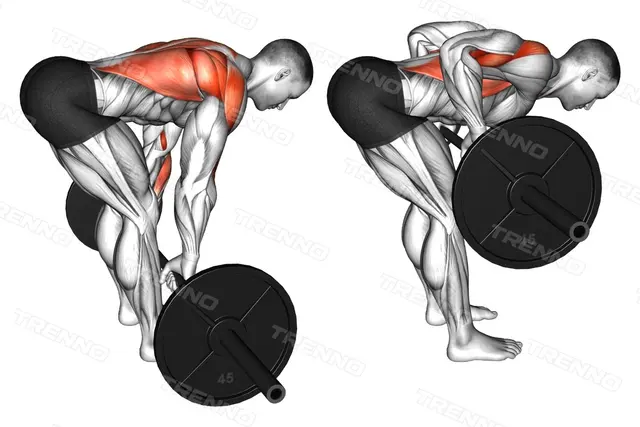
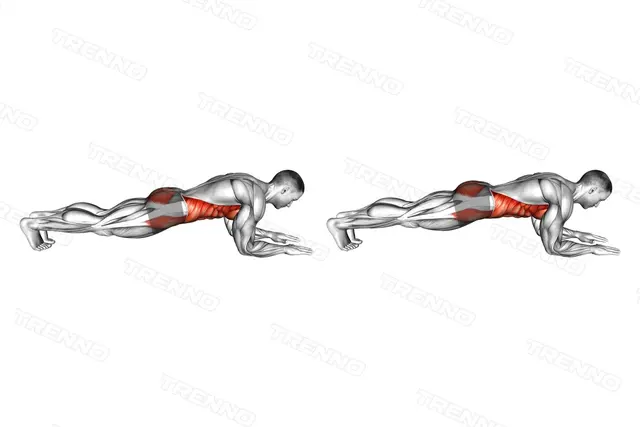
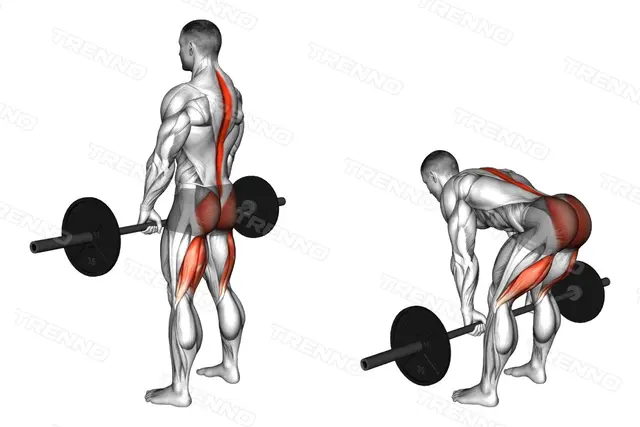
| Monday | Strength Workout A | Barbell Back Squat, Barbell Bench Press, Bent-Over Barbell Row | Plank |
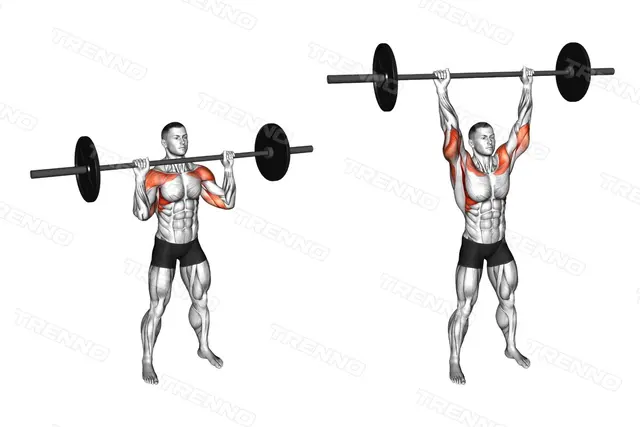
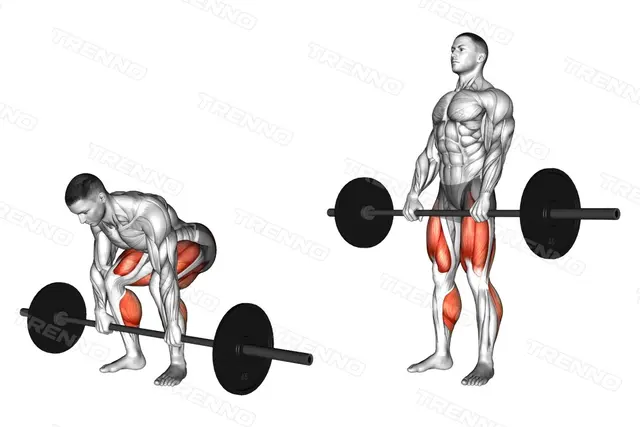
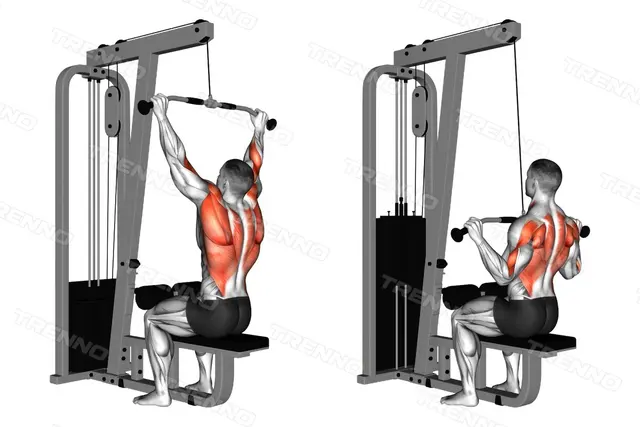
| Wednesday | Strength Workout B | Barbell Back Squat, Standing Barbell Overhead Press, Deadlift | Lat Pulldown |
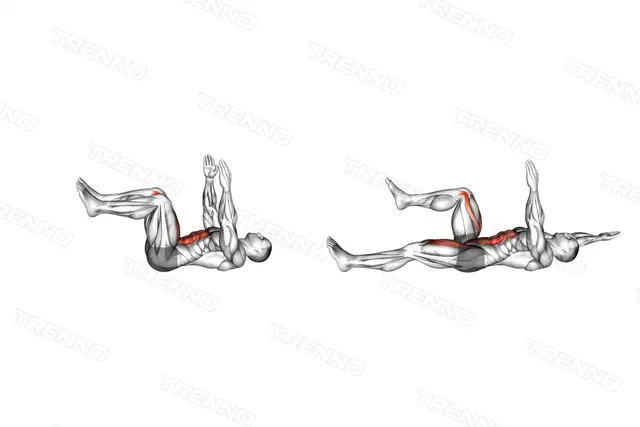
| Friday | Strength Workout C | Barbell Back Squat, Barbell Bench Press | Romanian Deadlift, Dead Bug |
Rest on the days between and at the weekend. The squat comes first every time because it is the lift the plan trains most. The two presses take turns, so the shoulders and the triceps get a day off from pressing between them, and the deadlift sits on Wednesday, two days from each of the other squat sessions.
| Lift | Sessions a week | Working sets a week |
|---|---|---|
| Barbell Back Squat | 3 | 9 sets of 5 |
| Barbell Bench Press | 2 | 6 sets of 5 |
| Standing Barbell Overhead Press | 1 | 3 sets of 5 |
| Bent-Over Barbell Row | 1 | 3 sets of 5 |
| Deadlift | 1 | 1 set of 5 |
The deadlift is usually the heaviest lift of the week and comes after a squat on the same day, so the plan gives it one hard set of five after three warm-up sets.
Why sets of five
A meta-analysis of 21 studies found that heavy loads, above 60 percent of the one-rep maximum, built more one-rep strength than light ones, while muscle growth was similar across loads (Schoenfeld and colleagues, 2017). To get better at lifting heavy weights, you practice lifting heavy weights. A set of five is heavy enough for that and short enough to keep every rep looking the same while you learn the lift.
The American College of Sports Medicine’s general advice for novices is loads for 8 to 12 reps, and heavy loads of 1 to 6 reps later on, for strength. This plan starts with fives because its goal is the three lifts; the Lat Pulldown and the Romanian Deadlift still run 8 to 12.
Sets, reps, rest and effort
- The main lifts: 3 sets of 5 with 3:00 of rest, 2:30 on the row. Two warm-up sets before the squat, the bench press and the overhead press, one before the row, three before the deadlift.
- The rest of the session: 3 sets of 8 to 12 on the pulldown and the Romanian deadlift with 1:30 of rest; the Plank for 30 seconds and the Dead Bug for 8 to 12, with a minute of rest.
For untrained lifters, rests of 1 to 2 minutes were enough to gain strength in a review of 23 studies, and longer rests paid off once lifters were trained (Grgic and colleagues, 2018). The plan’s three minutes are generous in the first weeks and welcome later, when every set of five is heavy.
Effort: a set counts when all five reps look like the first. In the first weeks you will finish sets with 2 or 3 reps to spare; that is the point, because the weight rises every session. When a set falls short or the form breaks, the rule is simple: repeat the weight next time.
Warming up to the working weight
The warm-up sets climb from the empty bar to the working weight, fewer reps as the weight rises. It is common practice rather than a finding from research. A squat of 60 kg (about 130 lb) with the plan’s two warm-up sets:
| Set | Weight | Reps |
|---|---|---|
| Warm-up 1 | 20 kg, the empty bar | 5 |
| Warm-up 2 | 40 kg | 3 |
| Working sets | 60 kg | 3 sets of 5 |
In Trenno, mark these sets as warm-ups: they then stay out of your tonnage, records and charts, unless you choose to count them in Settings.
How to progress
This is linear progression: every session in which all the sets of five are complete, add the smallest step your gym has. On a barbell that is usually two 1.25 kg plates, 2.5 kg in all, or two 2.5 lb plates in a gym that loads pounds. The squat can move up three times a week. Two weeks of it:
| Session | Weight | Reps per set | Next session |
|---|---|---|---|
| Monday, week 1 | 40 kg (about 90 lb) | 5, 5, 5 | add 2.5 kg |
| Wednesday | 42.5 kg | 5, 5, 5 | add 2.5 kg |
| Friday | 45 kg | 5, 5, 5 | add 2.5 kg |
| Monday, week 2 | 47.5 kg | 5, 5, 4 | same weight |
| Wednesday | 47.5 kg | 5, 5, 5 | add 2.5 kg |
| Friday | 50 kg | 5, 5, 5 | add 2.5 kg |
The upper-body lifts move more slowly: the bench press has two chances a week, the overhead press one, and the same step is a larger share of a lighter bar. Fractional plates of 0.5 kg or 1.25 lb make the overhead press last longer. Our progressive overload guide explains why the smallest step matters.
When the weight stops going up
Sooner or later a lift falls short at the same weight for two or three sessions in a row, with sleep and food in order. Reset that lift, as the progressive overload guide describes: take 10 percent off and climb back over two weeks.
The plan has no planned lighter week. In a 2024 survey of 246 competitive strength and physique athletes, the typical lighter week came every 5 to 6 weeks and kept the same days and exercises with fewer sets, fewer reps and less weight (Rogerson and colleagues, 2024). A full week off is a different thing: in a 9-week study of trained lifters it left muscle growth unchanged but cost some of the strength gains (Coleman and colleagues, 2024). If you take a week, make it lighter, not off.
When resets stop working, or the 12 weeks are over, move to the intermediate version below.
The intermediate version
| Beginner Strength Barbell, 3 days | Intermediate Full-Body Barbell, 3 days | |
|---|---|---|
| Main lifts | 3 sets of 5 | 5 sets of 5 on most |
| Squats | Back squat 3 times a week | Back squat twice, front squat once |
| Working sets a week | 34 | 52 |
| A session | 43 to 46 minutes | 58 to 68 minutes |
Intermediate Full-Body Barbell, 3 days keeps the idea and adds work: more sets on the main lifts, a Front Squat and Incline Barbell Bench Press day, and pull-ups. Start it with your last working weights.
Substitutions
| Instead of | If | Do |
|---|---|---|
| Barbell Back Squat | No rack is free | Goblet Squat |
| Barbell Bench Press | No bench is free | Dumbbell Bench Press |
| Deadlift | Pulling from the floor is uncomfortable | Trap Bar Deadlift |
| Bent-Over Barbell Row | Your lower back tires first | Seated Cable Row |
| Lat Pulldown | The station is busy | Pull-Up (Assisted) |
Keep the sets, the reps and the rest of the lift you replace.
How long a session takes
Counted at about 40 seconds a working set, the rest the plan prescribes after each set, a minute per warm-up set and 5 minutes to load the bar and move between stations: Strength Workout A takes about 46 minutes, B about 44 and C about 43. More than half of each session is rest, 25 to 29 minutes of it.
Common mistakes
- Jumping more than the smallest step. A 5 kg jump feels fine for two weeks and then stalls the lift early.
- Counting ugly reps. A set of five that falls apart is not complete; repeat the weight.
- Skipping the warm-up sets to save time. They take a few minutes and prepare every working set after them.
- Adding exercises. The plan is short on purpose: its work is the three lifts, and they need you fresh.
FAQ
Is three sets of five enough for a beginner?
For the first months, yes: the squat gets 9 working sets a week and the bench press 6, and the weight rises every session it can. When it stops rising, the intermediate version adds sets.
How deep should I squat?
As deep as you can with a flat back and your heels down. In a 10-week study, full squats built more glute and inner-thigh muscle than half squats, and a bigger full squat (Kubo and colleagues, 2019).
How long can I keep adding weight every session?
For as long as the sets of five keep coming. Usually the presses slow first; the log shows it before you feel it.
Can I use this plan for muscle as well?
It builds some, but it is written for strength. The 3-day full-body plan trains more exercises for more sets.
Sources
- Schoenfeld BJ, Grgic J, Ogborn D, Krieger JW. Strength and hypertrophy adaptations between low- vs. high-load resistance training: a systematic review and meta-analysis. Journal of Strength and Conditioning Research, 2017.
- American College of Sports Medicine. Progression models in resistance training for healthy adults. Medicine and Science in Sports and Exercise, 2009.
- Grgic J, Schoenfeld BJ, Skrepnik M, Davies TB, Mikulic P. Effects of rest interval duration in resistance training on measures of muscular strength: a systematic review. Sports Medicine, 2018.
- Rogerson D, Nolan D, Androulakis Korakakis P, Immonen V, Wolf M, Bell L. Deloading practices in strength and physique sports: a cross-sectional survey. Sports Medicine Open, 2024.
- Coleman M and colleagues. Gaining more from doing less? The effects of a one-week deload period during supervised resistance training on muscular adaptations. PeerJ, 2024.
- Kubo K, Ikebukuro T, Yata H. Effects of squat training with different depths on lower limb muscle volumes. European Journal of Applied Physiology, 2019.
Both programs are in Trenno’s Explore with their days, sets and rest times. The previous session’s sets show beside the empty ones, so “5, 5, 5 last time” tells you to load the next plate, and the rest timer starts when you tick a set.