
Who this plan is for
Two full-body sessions a week train every major muscle group, and that is the public health minimum: the WHO and the Physical Activity Guidelines for Americans both ask adults for muscle-strengthening activities that involve all major muscle groups on 2 or more days a week.
The plan above is written for your first months in a gym: never lifted, or back after a long break. Most of its exercises are machines, which keep the path of the weight fixed, so the first weeks go into effort rather than balance; the second day adds a barbell hinge and a dumbbell press. It suits a week with room for two sessions and not reliably for three: shift work, small children, travel.
Pick another plan if:
- You can count on three days. The 3-day full-body plan trains each muscle more often and gives it more sets.
- You have lifted for six months or more and want as much muscle as your week allows. Two days are a floor; the upper/lower split trains every muscle twice a week with more sets, on four days.
How the week works
| Day | Option 1 | Option 2 | Option 3 |
|---|---|---|---|
| Monday | Full Body A | Rest | Rest |
| Tuesday | Rest | Full Body A | Full Body B |
| Wednesday | Rest | Rest | Rest |
| Thursday | Full Body B | Rest | Rest |
| Friday | Rest | Full Body B | Rest |
| Saturday | Rest | Rest | Full Body A |
| Sunday | Rest | Rest | Rest |
Leave two or three days between the sessions and alternate them: A, B, A, B. Both train the whole body, each through its own exercises:
| Body part | Full Body A | Full Body B | Sets a week |
|---|---|---|---|
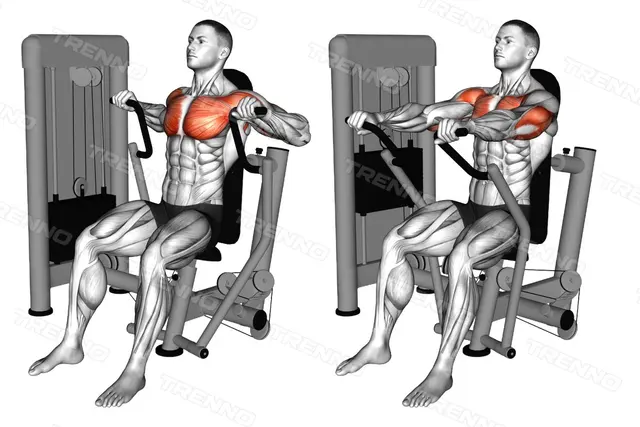
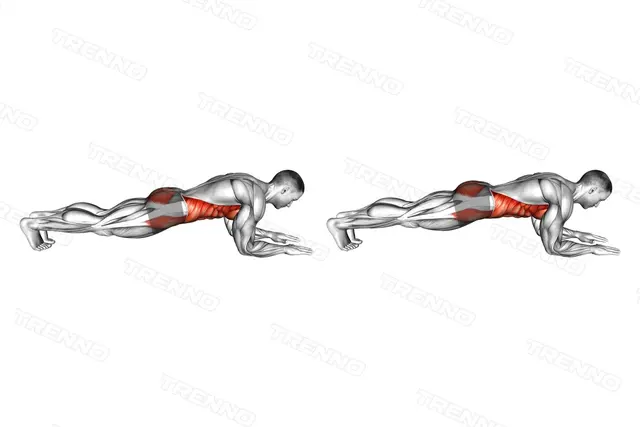
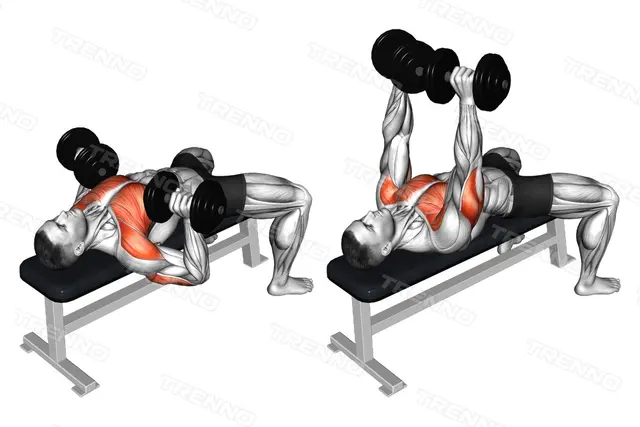
| Chest | Machine Chest Press | Dumbbell Bench Press | 6 |
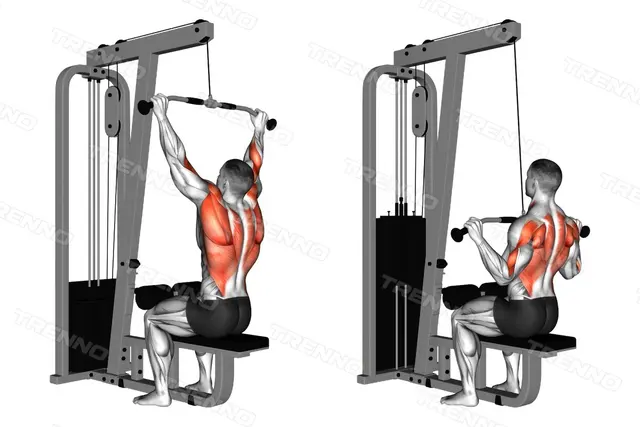
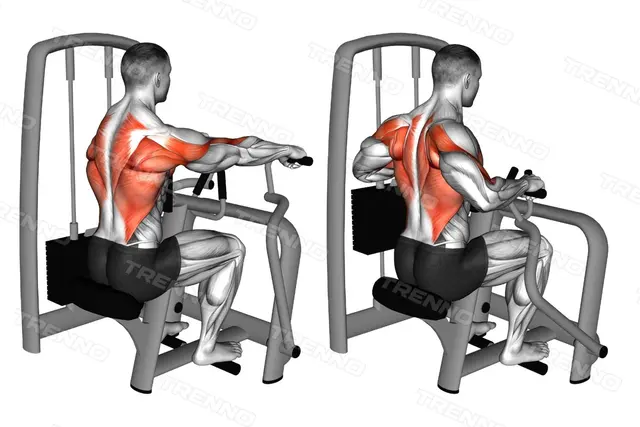
| Back | Lat Pulldown | Machine Seated Row | 6 |
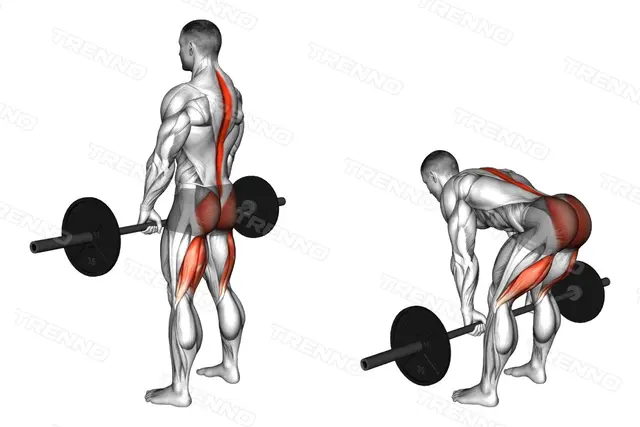
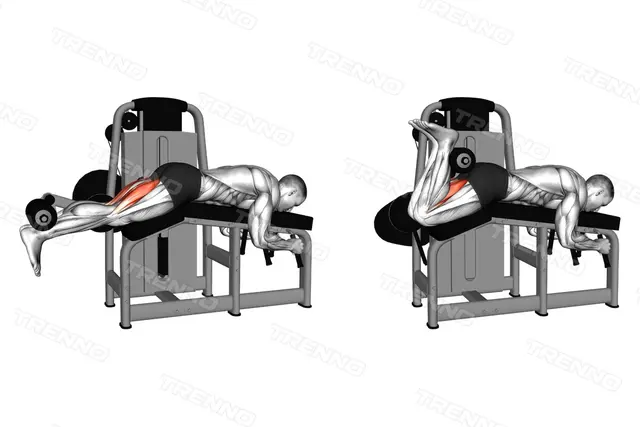
| Hamstrings | Romanian Deadlift, Lying Leg Curl | 6 | |
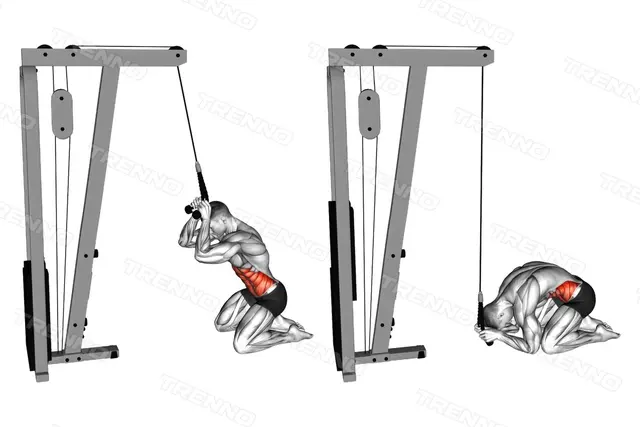
| Abs | Plank | Cable Crunch | 6 |
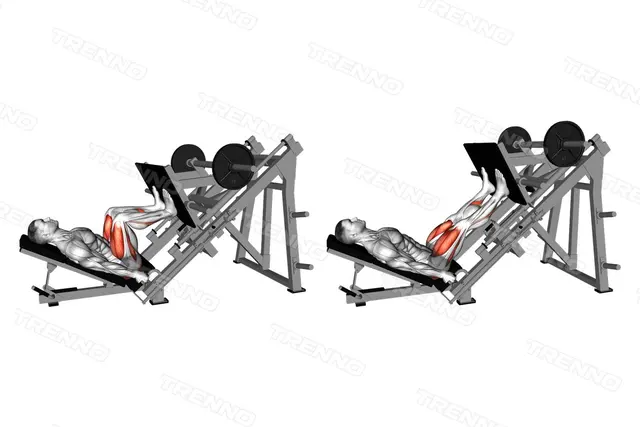
| Quadriceps | Leg Press | 3 | |
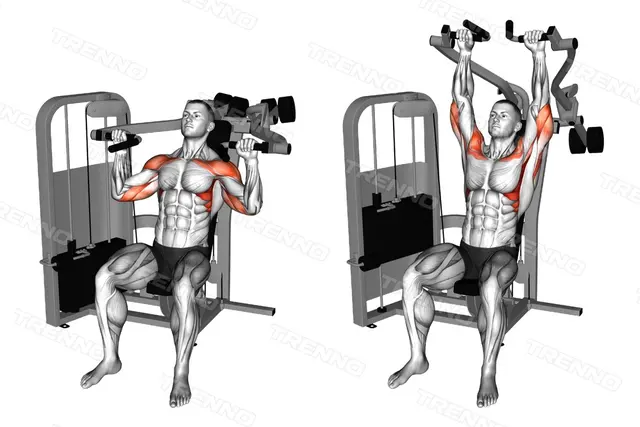
| Shoulders | Machine Shoulder Press | 2 |
So the chest, the back and the abs are trained twice a week, the legs once from the front and once from the back. The counts follow the body part each exercise is filed under in our exercise library. Some muscles collect more than the table shows: both presses work the front of the shoulders, and the leg press and the Romanian deadlift both list the glutes among their main muscles, so the glutes are trained on both days without an exercise of their own.
Is two days a week enough?
For a beginner, yes, and the research says why: muscle and strength follow the number of hard sets a week more than the number of days they are spread over.
- A meta-analysis of 25 studies found no real difference in muscle growth between training a muscle once, twice or three times a week when the weekly sets were the same (Schoenfeld and colleagues, 2019). For strength, more days brought more gains mainly because they brought more sets (Grgic and colleagues, 2018).
- A review of time-efficient training suggests at least 4 weekly sets per muscle group in the 6 to 15 rep range, and at least one leg press or squat, one upper-body pull and one upper-body push (Iversen and colleagues, 2021). Full Body A has all three, and four of the six body parts in the table get 6 sets.
- The American College of Sports Medicine recommends 2 to 3 training days a week for novices.
Where two days fall short is the total. The week holds 29 working sets; the three-day machine plan holds 43, and more weekly sets bring more growth in a graded way (Schoenfeld and colleagues, 2017). The front of the thighs gets only 3 sets here, all from the Leg Press: if your legs are the priority, a fourth set of it is the first one to add.
Sets, reps, rest and effort
Every exercise gets 3 sets except the Machine Shoulder Press, which gets 2. The Lat Pulldown, the Romanian Deadlift and the Dumbbell Bench Press run 8 to 12 reps; the other machines and the leg curl run 10 to 15, the Cable Crunch 12 to 15, and the Plank is held for 30 seconds. The big exercises rest 1:30; the leg curl, the plank and the crunch rest 1:00. The leg press and the Romanian deadlift each open with one warm-up set: the same movement with a light weight.
Effort is counted in reps in reserve (RIR): how many more clean reps you could have done when you stopped. In the first two weeks keep 3 in reserve while you find your weights. After that, end most sets with 1 or 2 in reserve.
How to progress
Use double progression, explained in our progressive overload guide: keep the weight until every set reaches the top of its range, then take the smallest step up and start again from the bottom. On a machine the step is the next plate of the stack, often 5 kg or 10 lb, which is a big jump on a light weight. That is why the machine ranges are wide. The Machine Chest Press, 3 sets of 10 to 15, once a week:
| Week | Weight | Reps per set | Next week |
|---|---|---|---|
| 1 | 25 kg (about 55 lb) | 12, 11, 10 | same weight |
| 2 | 25 kg | 13, 12, 12 | same weight |
| 3 | 25 kg | 15, 14, 13 | same weight |
| 4 | 25 kg | 15, 15, 15 | the next plate |
| 5 | 30 kg | 11, 10, 10 | same weight |
| 6 | 30 kg | 13, 12, 11 | same weight |
Each exercise comes round once a week, so one good session moves it forward and one missed session holds it back for a week.
When a third day fits
Two days are a plan, not a compromise, but a third day is the first upgrade when your week allows it. Three sessions take the week from 29 working sets to 43.
- Keep the machines: Beginner Full-Body Machines, 3 days, which the machine workout plan walks through. The Leg Press, the Machine Chest Press, the Lat Pulldown, the Machine Seated Row, the Machine Shoulder Press and the Cable Crunch all come with you, so start them at the weights you ended on here.
- Move to the barbell: Beginner Full-Body Barbell, 3 days builds the week on the squat, the bench press and the deadlift.
The 3-day full-body plan compares these and two more versions. If two days is still all you have when the 12 weeks end, run the plan again from the weights you finished with, or swap some exercises for the ones below.
Substitutions
| Instead of | If | Do |
|---|---|---|
| Leg Press | There is no leg press | Hack Squat or Goblet Squat |
| Machine Chest Press | The machine is busy | Push-Up |
| Lat Pulldown | The station is busy | Pull-Up (Assisted) |
| Machine Shoulder Press | There is no machine | Seated Dumbbell Overhead Press |
| Romanian Deadlift | No barbell is free | Dumbbell Romanian Deadlift |
| Lying Leg Curl | There is no lying curl | Seated Leg Curl |
| Machine Seated Row | The machine is busy | Seated Cable Row |
| Cable Crunch | The cables are busy | Dead Bug |
Keep the sets, the reps and the rest of the exercise you replace.
How long a session takes
Counted at about 40 seconds a working set, the rest the plan prescribes after each set, a minute per warm-up set and 5 minutes to set up and move between machines: Full Body A takes about 34 minutes, Full Body B about 36. Add 5 to 10 minutes of easy warm-up, and the week comes to about an hour and a half in the gym.
Common mistakes
- Training on back-to-back days. Saturday and Sunday leave five days without training; keep two or three days between the sessions.
- Letting the second session slide. With two days a week, one missed session halves the week. Move it to the next free day instead of skipping it.
- Staying at the starting weights. If the numbers in your log have not moved in a month, the sets are too easy.
- Adding exercises instead of weight. Five exercises a session are enough when each of them gets heavier.
FAQ
Can you build muscle training twice a week?
Yes, especially as a beginner. Growth follows the weekly hard sets, and this plan gives four of its six body parts 6 sets a week. More sets usually bring more growth, which is what a third day adds.
Which two days are best?
Any two with two or three days between them: Monday and Thursday, Tuesday and Friday, or Saturday and Tuesday.
What if I miss a session?
Do it on the next free day and keep the order, A then B. If a whole week is lost, carry on with the next session in line and the weights you last wrote down.
Are two long sessions better than three short ones?
With the weekly sets equal, research finds little difference between training a muscle once, twice or three times a week. Choose the week you will keep.
Should I do cardio on the other days?
For your health, yes. The WHO recommends 150 to 300 minutes of moderate aerobic activity a week for adults, on top of the two days of muscle strengthening. Walking, cycling or swimming on the days between fits around this plan.
Sources
- Bull FC and colleagues. World Health Organization 2020 guidelines on physical activity and sedentary behaviour. British Journal of Sports Medicine, 2020.
- Piercy KL, Troiano RP, Ballard RM and colleagues. The Physical Activity Guidelines for Americans. JAMA, 2018.
- Schoenfeld BJ, Grgic J, Krieger J. How many times per week should a muscle be trained to maximize muscle hypertrophy? Journal of Sports Sciences, 2019.
- Grgic J, Schoenfeld BJ, Davies TB, Lazinica B, Krieger JW, Pedisic Z. Effect of resistance training frequency on gains in muscular strength: a systematic review and meta-analysis. Sports Medicine, 2018.
- Iversen VM, Norum M, Schoenfeld BJ, Fimland MS. No time to lift? Designing time-efficient training programs for strength and hypertrophy: a narrative review. Sports Medicine, 2021.
- Schoenfeld BJ, Ogborn D, Krieger JW. Dose-response relationship between weekly resistance training volume and increases in muscle mass: a systematic review and meta-analysis. Journal of Sports Sciences, 2017.
- American College of Sports Medicine. Progression models in resistance training for healthy adults. Medicine and Science in Sports and Exercise, 2009.
The program is in Trenno’s Explore with both days, their sets and their rest times. The previous session’s sets show beside the empty ones, which matters on a plan where each exercise comes round once a week, and the rest timer starts when you tick a set.