Arms grow like every other muscle: from hard sets, enough of them each week, and a little more weight over time. They are also the muscles most often trained by guesswork, because every press and pull already works them. Here is how many sets they need, how to count them and the exercises that earn their place.
The short answer
Give the biceps and the triceps about 10 hard sets a week each, over two sessions, in sets of 8 to 15 reps that end one to three reps short of failure. Count your presses as half a set for the triceps and your rows and pulldowns as half a set for the biceps: a program with both covers about half of the 10 already, so 4 to 6 direct sets for each finish the job. Make one triceps exercise an overhead extension. In a 12-week trial it grew the triceps about 40 percent more than the same work with the arms at the sides.
The arm muscles
The biceps, at the front of the upper arm, bends the elbow and turns the palm up; the brachialis under it bends the elbow whatever the grip. The triceps, at the back, straightens the elbow. One of its three heads, the long head, also crosses the shoulder, so it is stretched most when the arm is overhead. The forearm muscles hold your grip and move the wrist, and the brachioradialis, on the thumb side, helps bend the elbow when the thumb points up. Our library lists the exercises for each group: Biceps, Triceps and Forearms.
What the studies found
The American College of Sports Medicine’s 2026 position stand, an overview of 137 systematic reviews, found more growth with 10 or more sets per muscle group a week, and the same growth from light and heavy loads as long as the sets were hard. For the arms:
- Pulls already train the biceps. In a 10-week trial, untrained men who did only lat pulldowns grew their elbow flexors about as much as men who did only curls: 6.1 against 5.8 percent. A 2026 meta-regression of 67 studies found that counting such helping sets as half a set fitted the results best.
- Curls still add something. In a small 2021 trial, 10 men trained one arm with curls and the other with one-arm rows. The curled arm’s elbow flexors grew 11 percent, the rowed arm’s 5.
- Overhead wins for the triceps. In the 12-week trial, 21 adults did cable extensions with one arm overhead and the other at the side. The overhead arm’s whole triceps grew 19.9 percent against 13.9, though it lifted about a third less weight.
- Use the whole curl. In an 8-week study, arms that curled only the bottom half, from straight arms to about 70 degrees, grew more near the elbow than arms that curled only the top half. When another study moved the hardest point of a preacher curl from the bottom to the top, the biceps grew the same. Lowering every curl to straight arms covers both.
Seven exercises for bigger arms
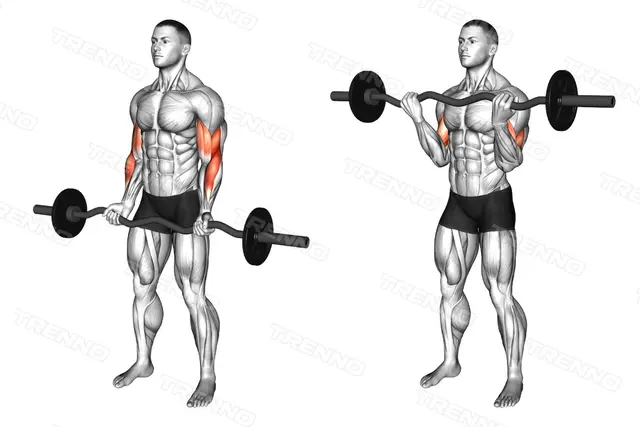
- EZ-Bar Biceps Curl. The curl that takes the most weight with good form; the angled grip spares the wrists. Cue: elbows stay at your sides.
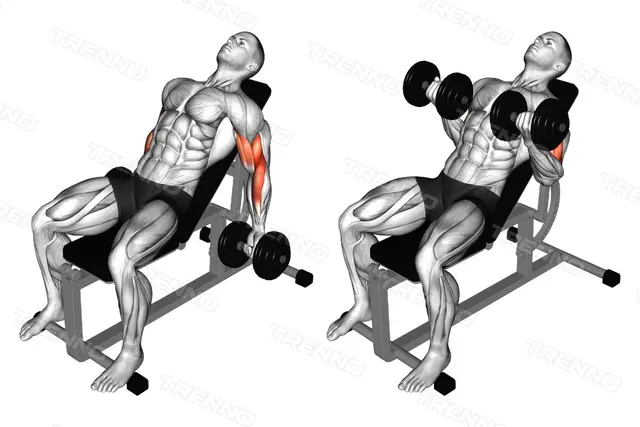
- Incline Dumbbell Curl. On a bench at about 45 degrees the arms hang behind the body, so each rep starts with the biceps stretched. Cue: keep the elbows back.
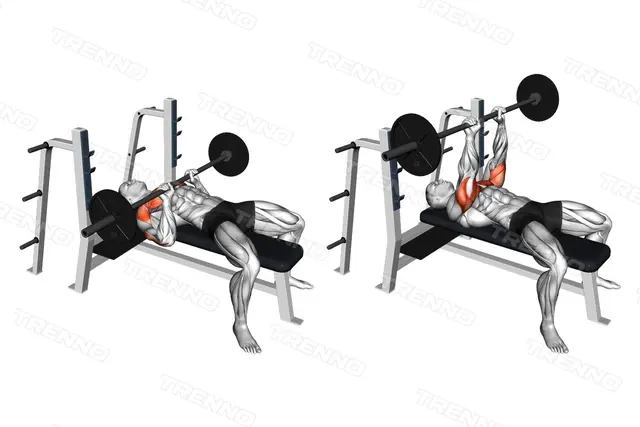
- Close-Grip Bench Press. The heavy lift for the triceps, with the chest and shoulders helping. Cue: hands about shoulder width, elbows close to the ribs.
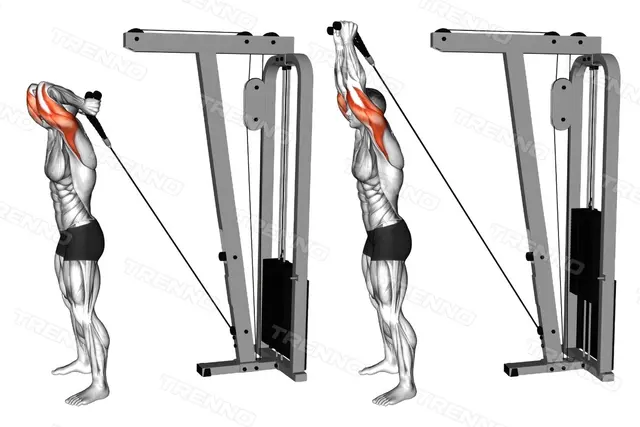
- Overhead Cable Triceps Extension. The exercise of the overhead trial. Cue: elbows point forward by your ears; let the rope travel back until the triceps stretch.
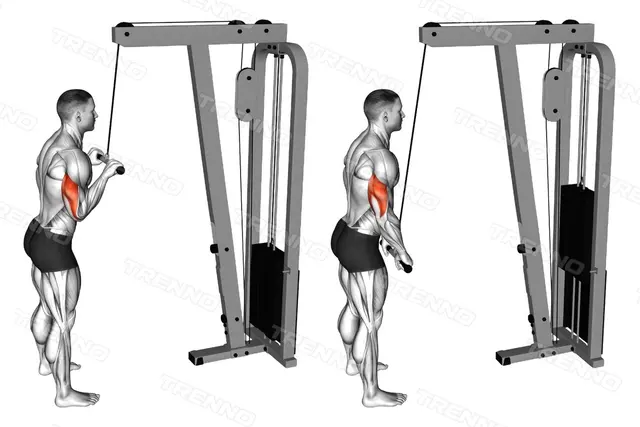
- Cable Triceps Pushdown. The arms-at-the-side partner, easy to load in small steps. Cue: pin the elbows to your ribs and straighten the arms fully.
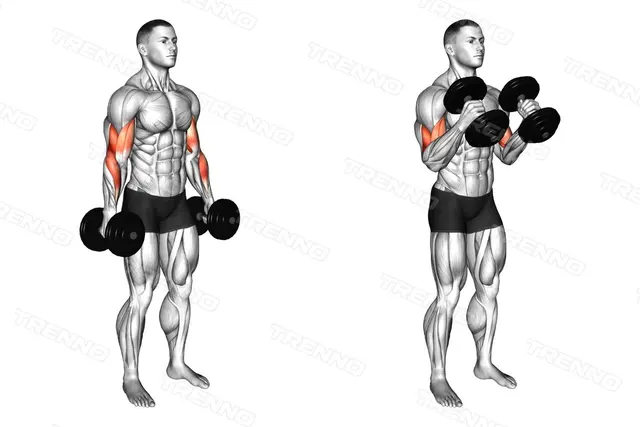
- Dumbbell Hammer Curl. Thumbs up, the brachioradialis leads, which is why our library files it under the forearms. Cue: the thumbs stay up all the way.
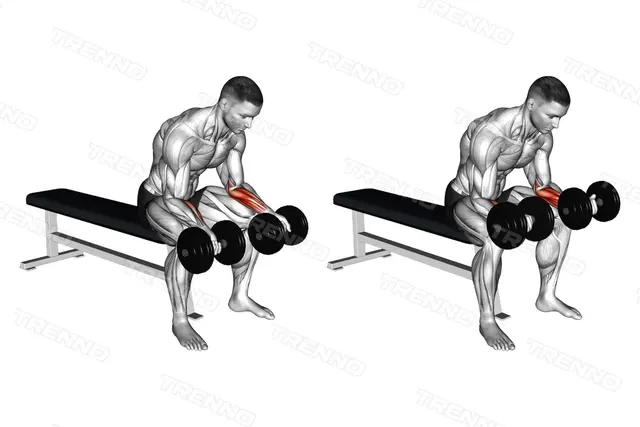
- Seated Dumbbell Wrist Curl. Direct work for the wrist flexors, which hold your grip on every pull. Cue: forearms on your thighs; only the wrists move.
What it means for your week
Two of our programs, counted from their rows, with every press and dip at half a set for the triceps and every row, pulldown and pull-up at half a set for the biceps:
| Sets a week | Push Pull Legs, 3 days | Body-Part Split, 5 days |
|---|---|---|
| Biceps, direct | 5 | 6 |
| Biceps, from pulls | 5 | 4.5 |
| Triceps, direct | 5 | 6 |
| Triceps, from presses | 5 | 10 |
| Total, biceps and triceps | 10 and 10 | 10.5 and 16 |
Intermediate Push Pull Legs, 3 days lands both at 10, the triceps on the Push Day and the biceps on the Pull Day. The Body-Part Split, 5 days gives the arms a day of their own, Arms and Abs, where a curl and a triceps exercise take turns; its chest and shoulder days bring the triceps to 16. How to count the other muscles is in How Many Sets per Muscle per Week.
A two-session week
Arms need no day of their own. Add these two blocks to the end of two sessions you already do, such as a push day and a pull day:
| Muscle | Session A | Session B |
|---|---|---|
| Biceps | EZ-Bar Biceps Curl, 3 × 8 to 12 | Incline Dumbbell Curl, 3 × 10 to 15 |
| Triceps | Overhead Cable Triceps Extension, 3 × 10 to 15 | Close-Grip Bench Press, 3 × 6 to 10 |
| Forearms | Dumbbell Hammer Curl, 2 × 10 to 15 | Seated Dumbbell Wrist Curl, 2 × 12 to 20 |
Rest a minute between sets, a minute and a half after the Close-Grip Bench Press. That is 6 direct sets each for the biceps and the triceps; with the half sets from a normal week of presses and rows, both land near 10 to 12. If your week has little pressing or pulling, add a set to each curl and extension, or run the Arms Session routine in Explore once a week: about 30 minutes, 6 sets for the biceps, 9 for the triceps and 3 of the Cable Hammer Curl.
In Trenno, Combine into superset on an exercise card pairs a curl with a triceps exercise, so each rests while the other works. Tap the figure on a workout’s totals card, or on a finished workout, and Muscle Distribution lists the sets each muscle group got, the upper arms and the forearms among them; a set where a muscle only helps counts as part of a set.
How to progress
Arm exercises move small weights, so every step is a big one: from a 10 kg (about 22 lb) dumbbell to a 12 kg one is a fifth more weight. Use double progression: stay at one weight until every set reaches the top of its range, then take the next step and start again at the bottom. When the next dumbbell is too big a jump, widen the range to 8 to 15 or add a set, as Progressive Overload explains.
Mistakes and myths
- Swinging the weight up. When the hips start the curl, the biceps skip the hardest part. Go lighter and keep the body still.
- Stopping short at the bottom. The half of the curl nearest straight arms grew more muscle in one study above. Lower all the way.
- Only pushdowns. In the trial, the arms-at-the-side extension grew less triceps than the overhead one; keep both.
- Piling arm work on a heavy week. Twenty direct sets on top of pressing and pulling days is a lot to recover from. Count the half sets first.
FAQ
Are chin-ups enough for the biceps?
For a beginner, nearly: in the pulldown trial above, pulling alone grew the elbow flexors as much as curls. Once the arms lag behind, add a few sets of curls, which did more than rows in the smaller trial.
Should arms get a day of their own?
Only if your split already has one, like the Body-Part Split. At the same weekly sets, one session or two built about the same muscle in a 2019 meta-analysis of 25 studies.
Do I need to train my forearms?
Not always. Every row, pulldown and deadlift makes the forearms hold on, and the hammer curl works the brachioradialis. Add wrist curls if your grip gives out before your back does.
Sources
- Currier BS, D’Souza AC, Singh MAF, et al. American College of Sports Medicine Position Stand. Resistance Training Prescription for Muscle Function, Hypertrophy, and Physical Performance in Healthy Adults: An Overview of Reviews. Medicine and Science in Sports and Exercise, 2026.
- Pelland JC, Remmert JF, Robinson ZP, Hinson SR, Zourdos MC. The Resistance Training Dose Response: Meta-Regressions Exploring the Effects of Weekly Volume and Frequency on Muscle Hypertrophy and Strength Gains. Sports Medicine, 2026.
- Gentil P, Soares S, Bottaro M. Single vs. Multi-Joint Resistance Exercises: Effects on Muscle Strength and Hypertrophy. Asian Journal of Sports Medicine, 2015.
- Mannarino P, Matta T, Lima J, Simão R, Freitas de Salles B. Single-Joint Exercise Results in Higher Hypertrophy of Elbow Flexors Than Multijoint Exercise. Journal of Strength and Conditioning Research, 2021.
- Maeo S, Wu Y, Huang M, et al. Triceps brachii hypertrophy is substantially greater after elbow extension training performed in the overhead versus neutral arm position. European Journal of Sport Science, 2023.
- Pedrosa GF, Simões MG, Figueiredo MOC, et al. Training in the Initial Range of Motion Promotes Greater Muscle Adaptations Than at Final in the Arm Curl. Sports, 2023.
- Nunes JP, Jacinto JL, Ribeiro AS, et al. Placing Greater Torque at Shorter or Longer Muscle Lengths? Effects of Cable vs. Barbell Preacher Curl Training on Muscular Strength and Hypertrophy in Young Adults. International Journal of Environmental Research and Public Health, 2020.
- Schoenfeld BJ, Grgic J, Krieger J. How many times per week should a muscle be trained to maximize muscle hypertrophy? A systematic review and meta-analysis of studies examining the effects of resistance training frequency. Journal of Sports Sciences, 2019.