Legs are three muscle groups that grow from different exercises. The quadriceps at the front grow from squats and presses; the hamstrings at the back need a hinge and a leg curl; the calves need raises of their own. A squat alone, however heavy, leaves the hamstrings and the calves to other exercises. The glutes, the fourth, have their own plan in Glute Workout Plan.
The short answer
Give the quadriceps, the hamstrings and the calves about 10 hard sets a week each, over two sessions, in sets of 6 to 15 reps that end one to three reps short of failure. For the quadriceps, a squat or a leg press plus the leg extension; for the hamstrings, the Romanian Deadlift plus a seated leg curl; for the calves, standing calf raises lowered into a full stretch. The seated curl and the standing raise each grew their muscle clearly more than the lying curl and the seated raise in trials.
The leg muscles
The quadriceps are four muscles at the front of the thigh that straighten the knee; one of them, the rectus femoris, also crosses the hip. The hamstrings at the back bend the knee, and all but one of them also straighten the hip, which is why hinges train them. The calves are two muscles: the gastrocnemius, which crosses the knee and is stretched when the leg is straight, and the soleus beneath it. Our library lists the exercises under Quadriceps, Hamstrings and Calves.
What the studies found
The American College of Sports Medicine’s 2026 position stand, an overview of 137 systematic reviews, found more muscle growth with 10 or more sets per muscle group a week, from light or heavy loads alike when the sets were hard. For the legs:
- Squats grow most of the thigh, not all of it. In a 10-week trial of 17 men, full and half squats both grew the quadriceps by about 5 percent, but neither grew the rectus femoris or the hamstrings. Full squats grew the glutes and the inner thighs more than half squats.
- The leg extension fills the gap. In a 2021 trial, the leg extension grew all three regions of the rectus femoris, while squats on a Smith machine grew only the middle of the outer thigh.
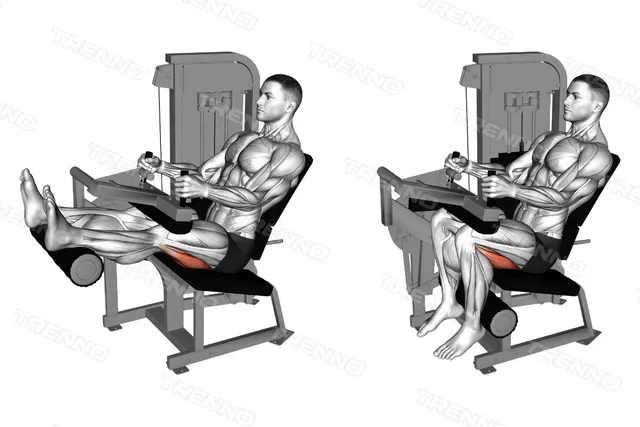
- Seated beats lying for the hamstrings. In a 12-week trial, 20 adults trained one leg with the seated leg curl and the other lying face down. The seated leg’s hamstrings grew 14 percent, the lying leg’s 9.
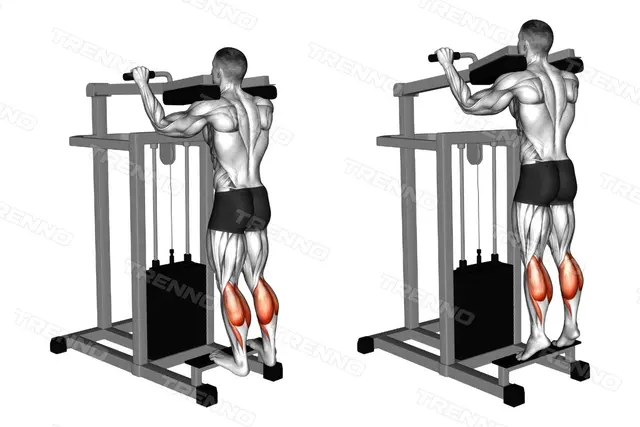
- Standing beats seated for the calves. In a 12-week trial of 14 adults, the calf raised standing grew its gastrocnemius by 9 to 12 percent, the calf raised seated by 2 percent or less. The soleus grew about the same in both.
- The bottom of the calf raise counts most. In an 8-week trial of 42 women, calf raises in the lower half of the range, heels below the step, grew the inner calf 15 percent, full raises 7 and upper-half raises 3.
Seven exercises for bigger legs
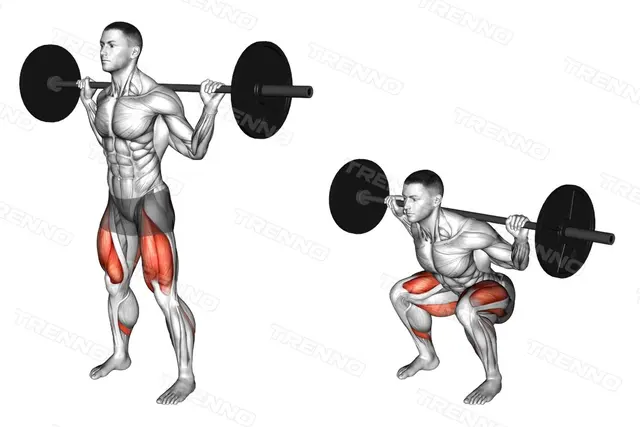
- Barbell Back Squat. The heavy lift for the quadriceps and the glutes. Cue: brace, keep the whole foot planted and reach parallel or below.
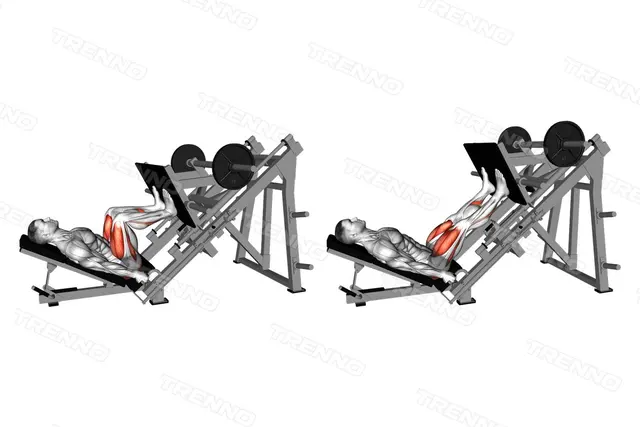
- Leg Press. Quadriceps work without balancing a bar, easy to load in small steps. Cue: go as deep as your lower back stays on the pad.
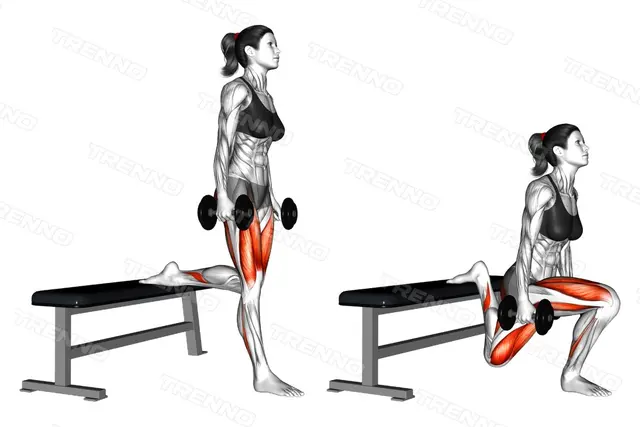
- Bulgarian Split Squat. One leg at a time, rear foot on a bench, with little weight and no rack. Cue: lower straight down until the front thigh is near level.
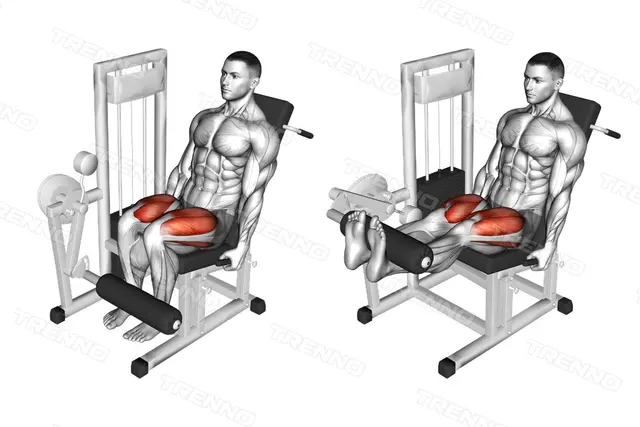
- Leg Extension. The one quadriceps exercise that reached the rectus femoris in the trials above. Cue: straighten the legs fully, hold a beat, and lower under control.
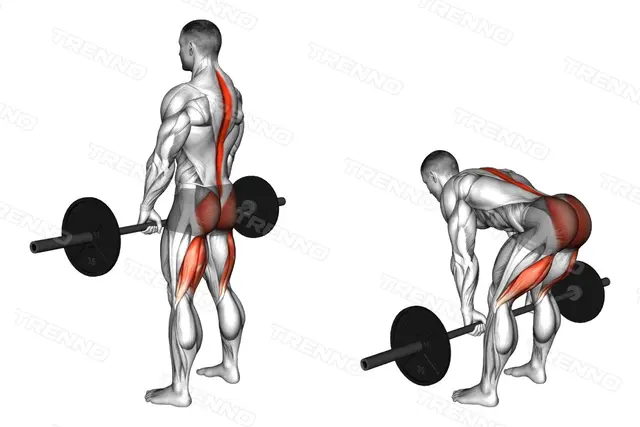
- Romanian Deadlift. The hinge for the hamstrings and the glutes. Cue: push the hips back with soft knees and stop when the hamstrings pull hard, around mid-shin.
- Seated Leg Curl. The curl that grew more hamstring. Cue: curl the heels as far under the seat as they go and hold the deepest point for a beat.
- Standing Calf Raise. The raise that grew the gastrocnemius. Cue: pause at the top, then lower until the heels drop below the edge into a stretch, with no bounce.
What it means for your week
Four of our programs, counted from their rows, each set going to the group the exercise is filed under in our library:
| Program | Quadriceps | Hamstrings | Calves |
|---|---|---|---|
| Push Pull Legs, 3 days | 7 | 6 | 4 |
| Upper/Lower, 4 days | 13 | 9 | 8 |
| Body-Part Split, 5 days | 7 | 6 | 4 |
| Push Pull Legs, 6 days | 17 | 9 | 8 |
The one-leg-day plans, Intermediate Push Pull Legs, 3 days and the Body-Part Split, 5 days, sit below 10 for all three: a start, with room to add a set or two. Intermediate Upper/Lower, 4 days and Advanced Push Pull Legs, 6 days train the legs twice a week and pair the exercises the studies compared: a seated and a lying leg curl, a standing and a seated calf raise. The squat also counts for the glutes, which our library lists among its main muscles.
A two-session week
Two leg sessions a week, such as the two lower days of an upper and lower split:
| Session A | Session B | |
|---|---|---|
| Quadriceps | Barbell Back Squat, 4 × 6 to 10 | Leg Press, 3 × 10 to 15; Leg Extension, 3 × 12 to 15 |
| Hamstrings | Romanian Deadlift, 3 × 8 to 12; Seated Leg Curl, 3 × 10 to 15 | Seated Leg Curl, 3 × 10 to 15 |
| Calves | Standing Calf Raise, 4 × 10 to 15 | Standing Calf Raise, 4 × 10 to 15 |
That is 10 sets for the quadriceps, 9 for the hamstrings and 8 for the calves. Rest two and a half minutes after the squat, a minute and a half after the Romanian Deadlift and the leg press, and a minute after the curls, the extensions and the calf raises, the rests our programs use. No rack or no leg press: the Bulgarian Split Squat takes the place of either.
In Trenno, Replace exercise on a card swaps the squat for the leg press when the rack is taken, for that workout. Tap the figure on a workout’s totals card, or on a finished workout, and Muscle Distribution lists the thighs, the glutes and the calves; a squat, which our library credits to the quadriceps and the glutes alike, splits its set between those two rows.
How to progress
Use double progression: stay at one weight until every set reaches the top of its range, then add the smallest step and start again at the bottom. On the squat and the Romanian Deadlift that is 2.5 to 5 kg (about 5 to 11 lb); the leg press and the calf machines take bigger steps. For the calves, count a rep only when the heels go below the step and the top is held for a moment. Progressive Overload has the rest of the method.
Mistakes and myths
- Squats as the whole leg day. They left the rectus femoris and the hamstrings unchanged in the trial above. Add the leg extension and a leg curl.
- Bouncing the calf raise. The stretched bottom grew the most calf. Lower slowly and pause there.
- Only seated calf raises. They grew the soleus but hardly the gastrocnemius. Do most of your calf sets standing.
- “Calves just don’t grow.” In the trials above they grew by up to 15 percent in 8 to 12 weeks when trained at long lengths.
- Half squats with a heavy bar. Full squats grew the glutes and the inner thighs more. Go as deep as you can with a flat back.
FAQ
Squat or leg press?
Both grow the quadriceps and, by our library’s lists, the glutes. The squat asks for balance and a rack; the leg press lets you push close to failure without a spotter. Our programs use both.
Do I need the leg extension?
For fuller quadriceps, yes: in the trials above it grew the rectus femoris, which squats did not.
How often should I train legs?
Once or twice a week. At the same weekly sets, the number of sessions made little difference in a 2019 meta-analysis of 25 studies, but two sessions keep each one shorter.
Sources
- Currier BS, D’Souza AC, Singh MAF, et al. American College of Sports Medicine Position Stand. Resistance Training Prescription for Muscle Function, Hypertrophy, and Physical Performance in Healthy Adults: An Overview of Reviews. Medicine and Science in Sports and Exercise, 2026.
- Kubo K, Ikebukuro T, Yata H. Effects of squat training with different depths on lower limb muscle volumes. European Journal of Applied Physiology, 2019.
- Zabaleta-Korta A, Fernández-Peña E, Torres-Unda J, Garbisu-Hualde A, Santos-Concejero J. The role of exercise selection in regional Muscle Hypertrophy: A randomized controlled trial. Journal of Sports Sciences, 2021.
- Maeo S, Huang M, Wu Y, et al. Greater Hamstrings Muscle Hypertrophy but Similar Damage Protection after Training at Long versus Short Muscle Lengths. Medicine and Science in Sports and Exercise, 2021.
- Kinoshita M, Maeo S, Kobayashi Y, et al. Triceps surae muscle hypertrophy is greater after standing versus seated calf-raise training. Frontiers in Physiology, 2023.
- Kassiano W, Costa B, Kunevaliki G, et al. Greater Gastrocnemius Muscle Hypertrophy After Partial Range of Motion Training Performed at Long Muscle Lengths. Journal of Strength and Conditioning Research, 2023.
- Schoenfeld BJ, Grgic J, Krieger J. How many times per week should a muscle be trained to maximize muscle hypertrophy? A systematic review and meta-analysis of studies examining the effects of resistance training frequency. Journal of Sports Sciences, 2019.