Gym talk splits the back into width and thickness. Width is the lats, the muscles that make the upper body look wider from the front; thickness is the muscles between and along the shoulder blades, which show from the side and the back. Both come from the same two movements: pulling down from overhead and pulling back from in front. Here is how many sets to give them, which exercises to use, and a week that puts them together.
The short answer
Give the back about 10 to 20 hard sets a week, over two sessions, split about evenly between vertical pulls (pull-ups and pulldowns) and rows. Sets of 6 to 15 reps that end one to three reps short of failure all build it. Grip width matters less than gym lore says: any grip from one to two times shoulder width worked the lats about equally hard in a study on electrodes, and the medium and narrow grips let people lift more.
The back muscles
The latissimus dorsi, the lats, run from the lower spine and the pelvis up to the upper arm and pull the arm down and back: they are the width. The trapezius runs from the neck to the middle of the back; its upper part lifts the shoulders, its middle and lower parts pull the shoulder blades together and down. The small muscles on the shoulder blade, the teres major, the teres minor and the infraspinatus, and the erector spinae along the spine complete the thickness. Pull-ups and pulldowns train mostly the lats; rows train the lats and the middle back together. Our library lists the exercises for this group under Back.
What the studies found
The American College of Sports Medicine’s 2026 position stand, an overview of 137 systematic reviews, found more muscle growth with 10 or more sets per muscle group a week, from light or heavy loads alike when the sets were hard. Most of what is known about single back exercises comes from electrodes, which measure how active a muscle is during a set, not how much it grows:
- Grip width changes little. With three grip widths on the lat pulldown, from one to two times shoulder width, 15 men showed similar lat activity over the whole rep, and lifted a little more with the medium and narrow grips than with the wide one.
- Palms forward works the lats more. In a study of four grips, the overhand pulldown drew more lat activity than the underhand one, whatever the width.
- Pull to the front. A 2026 review of 23 studies found the pulldown to the front of the head the most consistent choice for lat activity; pull-up grips made little difference to the lats.
- The chin-up adds arms. Compared with the pull-up, the chin-up worked the biceps and the chest harder, and the pull-up the lower trapezius. Against the lat pulldown, the chin-up worked the biceps and the muscles along the spine harder.
Six exercises for a bigger back
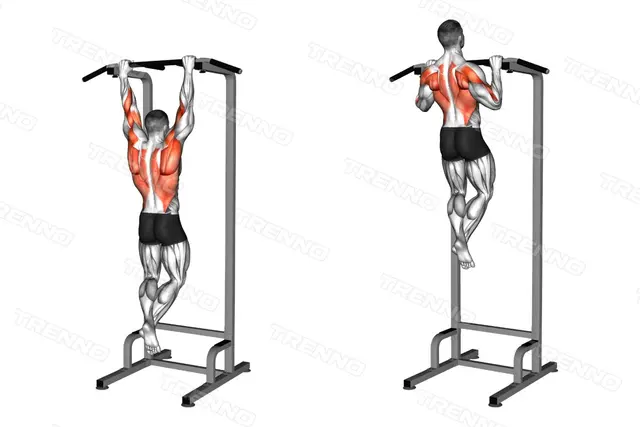
- Pull-Up. The vertical pull with your body as the weight. Cue: start each rep by pulling the shoulder blades down, and lower to straight arms.
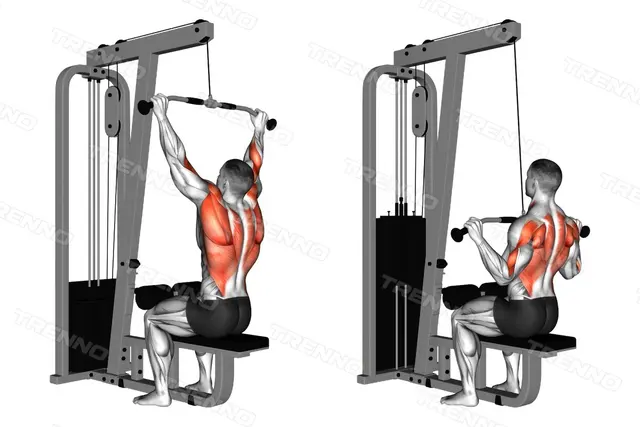
- Lat Pulldown. The same movement at any load, so it suits every level. Cue: pull the bar to the top of the chest, elbows down and back, and let it rise until the arms are straight.
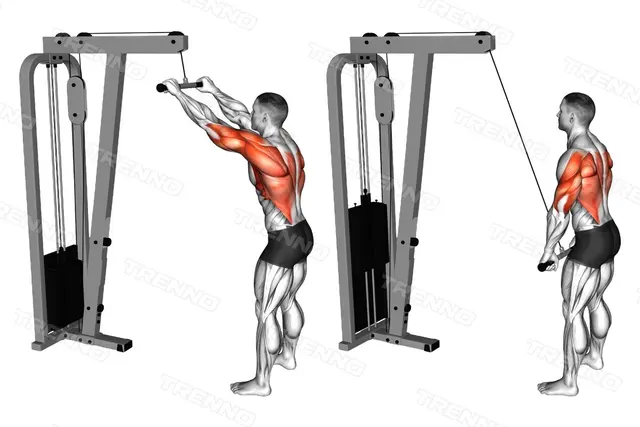
- Straight-Arm Lat Pulldown. The lats work without the biceps, so the arms never give out first. Cue: arms straight the whole way, the bar sweeping down to the thighs.
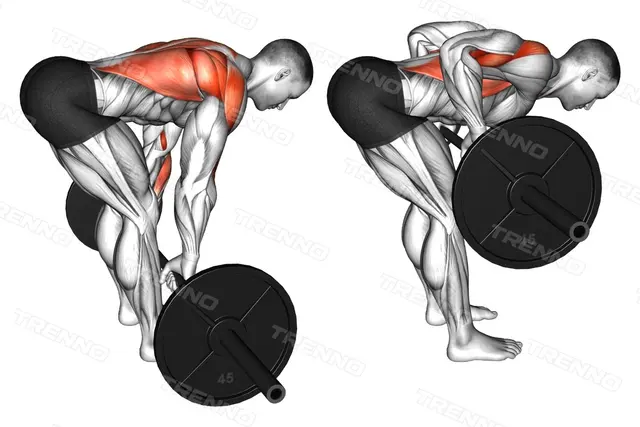
- Bent-Over Barbell Row. The heaviest row, for the middle back and the lats together. Cue: hinge to about 45 degrees with a flat back, keep that angle and pull the bar to the lower ribs.
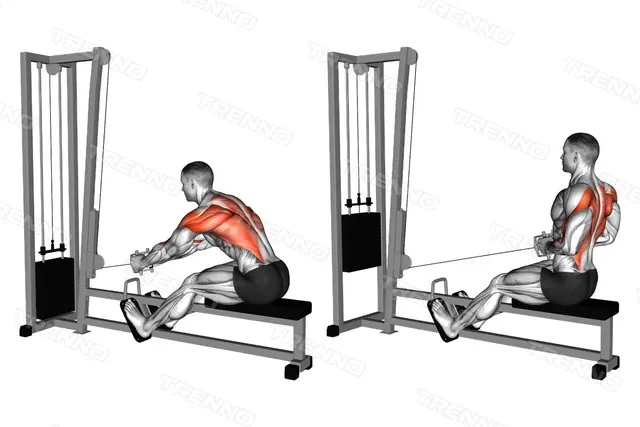
- Seated Cable Row. Steady cable tension, and no hinge to hold. Cue: pull to the lower ribs, elbows brushing your sides, and let the shoulder blades slide forward on the way back.
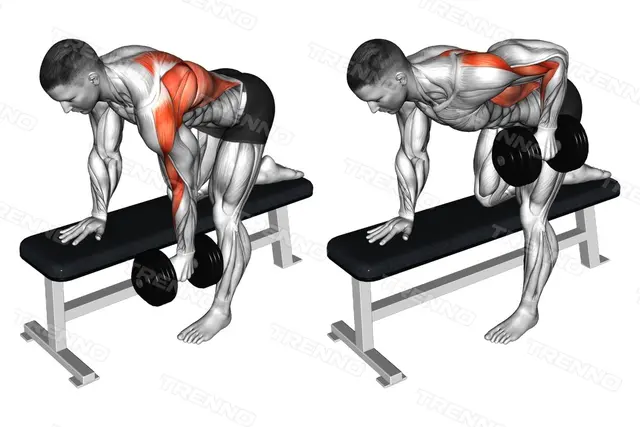
- One-Arm Dumbbell Row. One side at a time, with the other hand braced on a bench. Cue: pull the dumbbell to your hip without twisting the torso.
What it means for your week
Four of our programs, counted from their rows: the sets of pull-ups and pulldowns, and of rows, that each gives a week:
| Program | Pull-ups and pulldowns | Rows | Sessions |
|---|---|---|---|
| Push Pull Legs, 3 days | 3 | 7 | 1 |
| Upper/Lower, 4 days | 7 | 7 | 2 |
| Body-Part Split, 5 days | 6 | 3 | 1 |
| Push Pull Legs, 6 days | 7 | 10 | 2 |
Intermediate Upper/Lower, 4 days is the most even: each upper day has one vertical pull and one row, 14 sets a week. The Pull Day of Intermediate Push Pull Legs, 3 days leans on rows, 10 sets in one session. The Back Day of the Body-Part Split, 5 days opens with the Deadlift, which works the muscles along the spine, and its shoulder day adds 3 sets of shrugs for the upper trapezius. Advanced Push Pull Legs, 6 days reaches 17 over its two pull days.
A two-session week
Put the back into two sessions you already do, such as a pull day and an upper day:
| Session A | Session B | |
|---|---|---|
| Vertical | Pull-Up, 3 × 6 to 10 | Lat Pulldown, 3 × 8 to 12 |
| Row | Bent-Over Barbell Row, 3 × 6 to 10 | Seated Cable Row, 3 × 10 to 15 |
| Third | Straight-Arm Lat Pulldown, 2 × 12 to 15 | One-Arm Dumbbell Row, 2 × 8 to 12 |
That is 16 sets a week, half of them pulling down and half rowing. Rest two and a half minutes after the barbell rows, a minute and a half after the pull-ups, the pulldowns and the other rows, a minute after the straight-arm pulldowns: the rests our programs use for such exercises. No pull-up yet: do the Lat Pulldown in both sessions while you work through How to Do Your First Pull-Up.
How to progress
Use double progression: stay at one weight until every set reaches the top of its range, then add the smallest step and start again at the bottom. On a cable stack that is one plate. For pull-ups, add reps until you reach about 12 in the first set, then add weight with a belt or a dumbbell between the feet. Progressive Overload has the rest of the method.
In Trenno, log the loaded version as Pull-Up (Weighted): its weight column carries a plus sign, for the weight you add to your own. The assisted versions carry a minus, for the machine’s counterweight, so a smaller number there is progress. Tap the figure on a workout’s totals card and Muscle Distribution shows the sets the back got so far.
Mistakes and myths
- “A wide grip builds width.” One to two times shoulder width worked the lats about the same, and the narrower grips moved more weight.
- Pulling behind the neck. The pulldown to the front drew the most consistent lat activity. Bring the bar to the top of the chest.
- Heaving the row. When the torso rises to start each rep, momentum does the pulling. Keep the angle and take a lighter bar.
- Half reps. Stopping short of straight arms at the bottom of a pulldown or a row skips the stretch. Let the weight pull you all the way out.
- Only one kind of pull. Rows and vertical pulls share the lats but not the rest. Do both every week.
FAQ
Pull-ups or lat pulldowns?
Either for the lats. The pull-up asks for your whole body weight, so the pulldown is where most people start and where anyone can add weight in small steps. Do pull-ups when you can do sets of 6 or more.
Does the deadlift build the back?
It trains the muscles along the spine, which is why the Body-Part Split opens its back day with it. But our library files it under the glutes and lists no lats among its muscles, so it does not replace pulls and rows.
How many times a week should I train my back?
Once or twice. At the same weekly sets, the number of sessions made little difference in a 2019 meta-analysis of 25 studies. Two sessions keep each one shorter.
Sources
- Currier BS, D’Souza AC, Singh MAF, et al. American College of Sports Medicine Position Stand. Resistance Training Prescription for Muscle Function, Hypertrophy, and Physical Performance in Healthy Adults: An Overview of Reviews. Medicine and Science in Sports and Exercise, 2026.
- Andersen V, Fimland MS, Wiik E, Skoglund A, Saeterbakken AH. Effects of grip width on muscle strength and activation in the lat pull-down. Journal of Strength and Conditioning Research, 2014.
- Lusk SJ, Hale BD, Russell DM. Grip width and forearm orientation effects on muscle activity during the lat pull-down. Journal of Strength and Conditioning Research, 2010.
- Di Fonza D, Di Claudio G, Colantuono G, et al. Electromyographic Analysis of Latissimus Dorsi Activation During Common Resistance Training Exercises: A Narrative Review. Journal of Functional Morphology and Kinesiology, 2026.
- Youdas JW, Amundson CL, Cicero KS, et al. Surface electromyographic activation patterns and elbow joint motion during a pull-up, chin-up, or perfect-pullup rotational exercise. Journal of Strength and Conditioning Research, 2010.
- Doma K, Deakin GB, Ness KF. Kinematic and electromyographic comparisons between chin-ups and lat-pull down exercises. Sports Biomechanics, 2013.
- Schoenfeld BJ, Grgic J, Krieger J. How many times per week should a muscle be trained to maximize muscle hypertrophy? A systematic review and meta-analysis of studies examining the effects of resistance training frequency. Journal of Sports Sciences, 2019.