A pull-up lifts your whole body with your back and your arms, so the first one is a real strength test. You do not get there by trying and failing at full pull-ups. You get there by training the parts of the movement you can already do, one rung of a ladder at a time.
The short answer
Train three short sessions a week, each led by one step of the ladder: hang from the bar, pull the shoulder blades down from the hang, lower yourself slowly from the top, then pull with a band’s help. Do 3 to 8 hard, controlled reps a set, add rows for the pulling muscles, and move up a step once every set of the current one is steady. The plan above is built this way, in about 20 to 25 minutes a session.
Why the first one is hard
- It is strength for your body weight. In a study of 58 college students, the heaviest single pull-up the women could do, with a counterweight where needed, averaged 73 percent of their body weight: most could not lift all of it. The men averaged 116 percent. Among the women, a strong lat pulldown said little about the pull-up.
- Strength decides, and strength trains. In a training study of college women, those who could do a pull-up by the end had more strength for their body mass, and their body fat and their strength relative to lean mass predicted who would.
- The shoulder blades move first. On electrodes, pull-ups and chin-ups began with the lower trapezius, which draws the shoulder blades down, and the chest; the biceps and the lats finished the rep. That first part is what the scapular pull-up practices.
- Lowering is the half you can do first. A meta-analysis of 20 trials found that heavy lowering-only training raised strength more than lifting-only training, and the American College of Sports Medicine’s 2026 position stand found more muscle growth from lowering-only than from lifting-only work.
- Grip counts. In an 8-week trial, 30 inactive young men who could already do 3 to 4 pull-ups on average trained twice a week with assisted pull-ups, inverted rows, chin-ups and slow lowerings. Every group improved; the one that added grip training went from 4 pull-ups to about 13, and hanging time rose in all three.
The ladder
| Step | Exercise | Move up when |
|---|---|---|
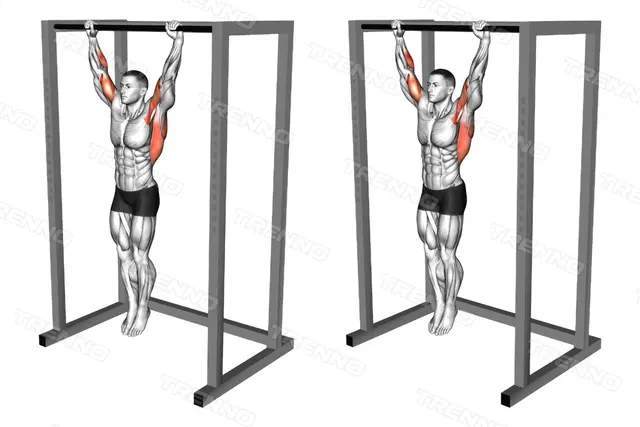
| 1 | Dead Hang | Four 20-second hangs feel easy |
| 2 | Scapular Pull-Up | You manage 4 sets of 8 |
| 3 | Negative Pull-Up | You manage 4 sets of 5 slow lowerings |
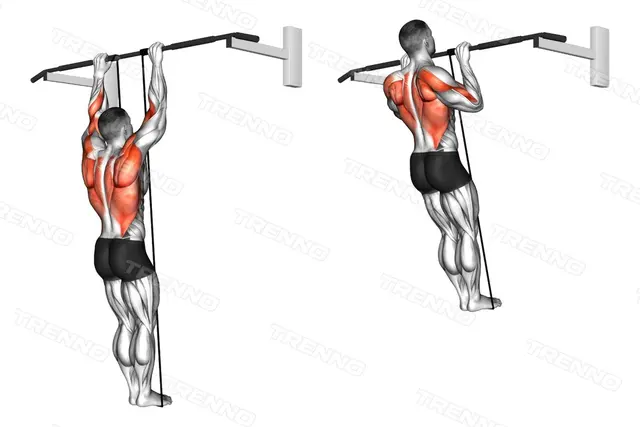
| 4 | Pull-Up (Band-Assisted) | You manage 3 sets of 8 with a light band |
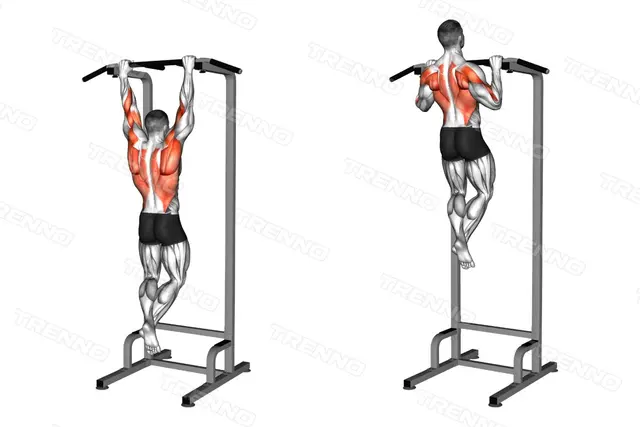
| 5 | Pull-Up | Your first clean rep |
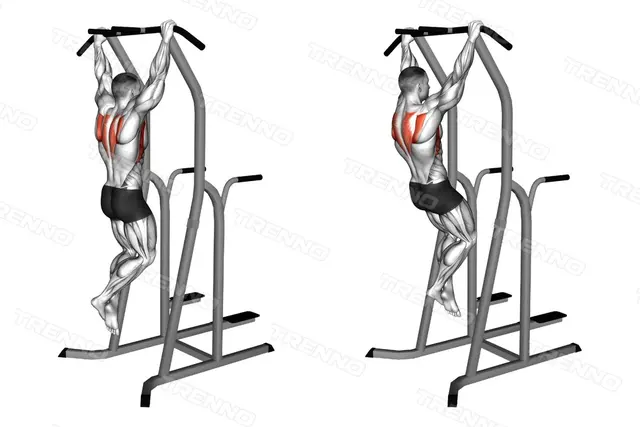
- Dead Hang. Grip and shoulders learn to carry your weight. Cue: hang long and quiet, without swinging, and step down before the grip fails completely.
- Scapular Pull-Up. The first pull of every pull-up. Cue: arms stay straight; only the shoulder blades move, down and together, and the body rises a few centimeters.
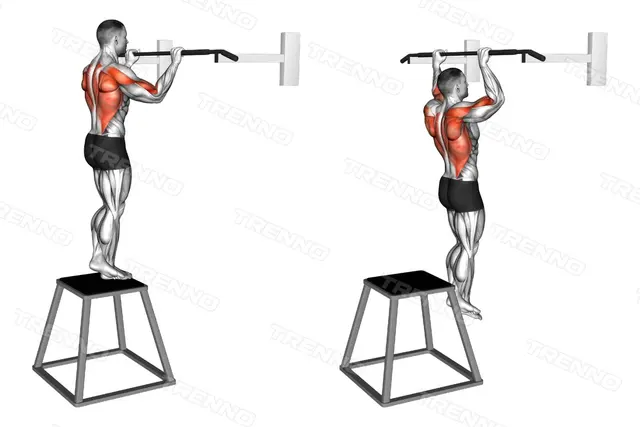
- Negative Pull-Up. Step up to the top, chin over the bar, and lower yourself as slowly as you can. Cue: fight hardest in the bottom third, where it wants to drop.
- Pull-Up (Band-Assisted). A long band looped over the bar, both feet in it, lightens the bottom of each rep. Cue: pause in the hang instead of riding the band’s bounce.
- Pull-Up. Cue: start by pulling the shoulder blades down, bring the chin over the bar, and lower to straight arms.
What it means for your week
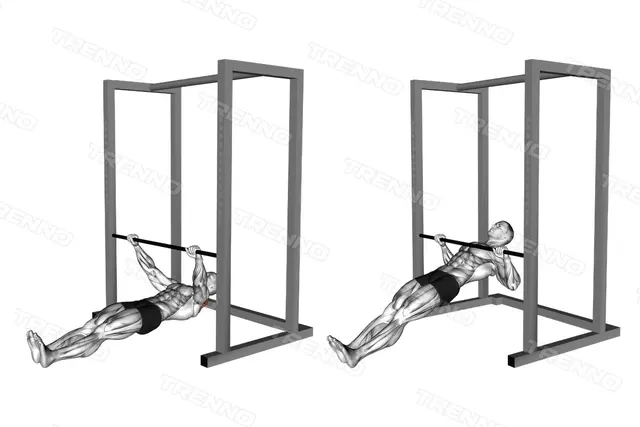
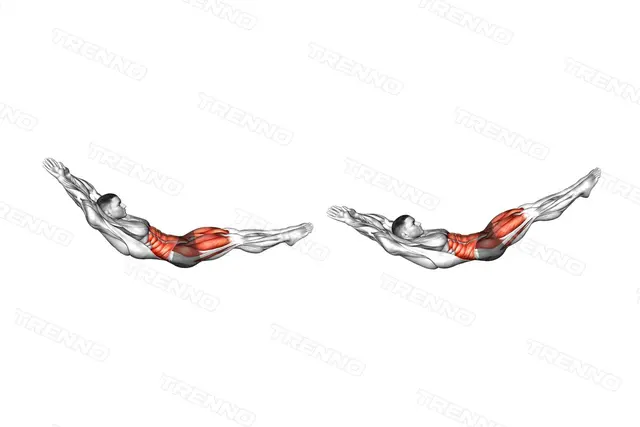
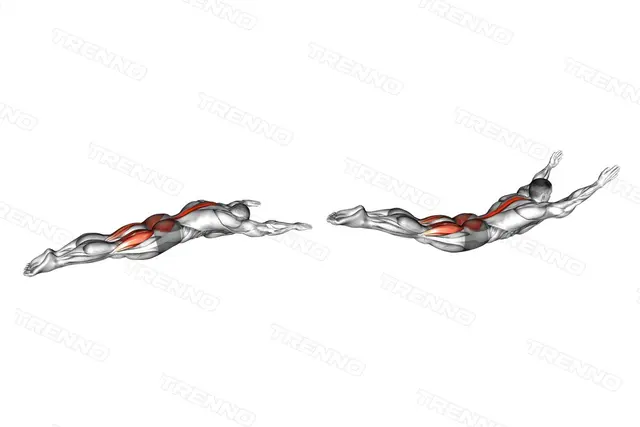
The plan above, First Pull-Up, 3 days, runs the first three rungs on three days of the week for 8 weeks: day A hangs, day B pulls the shoulder blades, day C lowers. Every day adds 4 sets of the Inverted Row, 12 a week, which trains the same pulling muscles with your feet on the floor, and one more exercise to balance the session: one for the abs, a hold for the lower back, and push-ups. As each day’s rung gets easy, that day moves up to the next one, so by the later weeks all three days pull harder. By the arithmetic Trenno uses for a routine’s Duration, the days take about 20, 25 and 25 minutes. It needs nothing but a bar to hang from and a low bar or a sturdy table to row under.
How to apply it
- Test yourself. Try a 20-second hang, then scapular pull-ups, then one slow lowering. Start at the first rung that is hard.
- Train three days a week, with a day between sessions.
- Stop every set with a rep or two in reserve. Clean, slow reps build the strength; sloppy ones only tire you.
- Move up one rung at a time when the table says so, and keep the rows.
- Once the first rep comes, do singles with a rest between them, then sets of 2 and 3, and let the band carry the extra reps.
In Trenno, the program is in Explore; starting it asks for a start date and your training days, then places the workouts on their dates. In a workout, Replace exercise on a card swaps a rung for the next one. The hang logs its seconds. On the assisted pull-up machine, the weight column carries a minus sign for the counterweight, and its records keep the least help you have needed, Min Assistance, and your Max Reps; a band has no number, so log the reps and write the band’s color in the exercise’s note.
Mistakes and myths
- Testing a full pull-up every session. A failed attempt teaches little and tires you for the rungs you can do. Train the rung you are on and test once every week or two.
- Dropping from the top of a negative. The slow part is the exercise. If you cannot lower for about three seconds, go back a rung.
- Kipping and swinging. Momentum hides the weak point instead of training it. Hang still before every rep.
- Only the lat pulldown. In the women above, pulldown strength said little about the pull-up. Keep it if you like it, but climb the ladder too.
- “Some people just can’t.” In the training study, the women who got there had more strength for their weight, and strength is what training builds.
FAQ
How long does it take?
It depends on your strength for your weight, and nobody can promise a date. The plan runs 8 weeks; if the first clean rep has not come by then, run it again from the rung you reached.
Band or assisted machine?
Either works. The machine gives you a number to lower week by week; the band helps most at the bottom and least at the top, and fits in a bag.
Is a chin-up easier?
It may be: with the palms facing you, the biceps and the chest worked harder on electrodes, so more muscle shares the pull. It is a fine first rep on the way to the pull-up.
Sources
- Johnson D, Lynch J, Nash K, Cygan J, Mayhew JL. Relationship of lat-pull repetitions and pull-ups to maximal lat-pull and pull-up strength in men and women. Journal of Strength and Conditioning Research, 2009.
- Flanagan SP, Vanderburgh PM, Borchers SG, Kohstall CD. Training college-age women to perform the pull-up exercise. Research Quarterly for Exercise and Sport, 2003.
- Youdas JW, Amundson CL, Cicero KS, et al. Surface electromyographic activation patterns and elbow joint motion during a pull-up, chin-up, or perfect-pullup rotational exercise. Journal of Strength and Conditioning Research, 2010.
- Roig M, O’Brien K, Kirk G, et al. The effects of eccentric versus concentric resistance training on muscle strength and mass in healthy adults: a systematic review with meta-analysis. British Journal of Sports Medicine, 2009.
- Currier BS, D’Souza AC, Singh MAF, et al. American College of Sports Medicine Position Stand. Resistance Training Prescription for Muscle Function, Hypertrophy, and Physical Performance in Healthy Adults: An Overview of Reviews. Medicine and Science in Sports and Exercise, 2026.
- Sepehri Rahnama H, Ganji S, Vadasz K, Prokai J. Comparative Effects of Core Versus Forearm Training on Pull-Up Repetition Performance in Physically Inactive Males. Sports, 2025.