Muscle grows when you ask it to do a little more than it can comfortably do, often enough, and give it what it needs to rebuild. That is the whole method. The rest is choosing how many sets, how heavy, how often, and sticking with it long enough to see the result. This guide puts those choices in order for your first months in the gym, and links the guides that go deeper into each one.
The short answer
Do two or three full-body sessions a week. Give each muscle about 6 to 10 hard sets a week at first, in sets of 6 to 15 reps that end one to three reps short of failure. Add reps, then a little weight, whenever the sets allow it. Eat about 1.6 g of protein per kilogram of body weight a day (about 0.7 g per pound), rest between sessions, and keep going for months: a plan you keep beats a perfect plan you drop.
What the research agrees on
The American College of Sports Medicine’s 2026 position stand pulled together 137 systematic reviews covering more than 30,000 people. Its findings make the beginner’s job simpler than gym talk suggests:
- Many kinds of training work. Compared with no training, resistance training of many forms built strength and muscle. Its main advice: train with high effort, at least twice a week, all the major muscle groups.
- Sets matter. Muscle grew more with 10 or more sets per muscle group a week. A 2017 meta-analysis of 15 studies linked each extra weekly set to a little more growth.
- Heavy or light both work. Loads from 30 to 100 percent of the one-rep maximum built similar muscle, as long as the sets were hard.
- Failure is optional. Taking sets to muscle failure did not consistently change the results.
- How you spread the sets is up to you. When the weekly sets were equal, training a muscle once or several times a week built about the same, a 2019 meta-analysis of 25 studies found. Two or three sessions a week simply make the sets easier to fit and to recover from.
The WHO guidelines ask every adult for muscle-strengthening activity on two or more days a week, so two days is the floor for health as well as for progress.
The six pieces, with the guide for each
| Piece | For your first months | Read more |
|---|---|---|
| Sessions | 2 or 3 full-body days a week | How Many Days a Week Should You Work Out? |
| Sets | 6 to 10 hard sets per muscle a week | How Many Sets per Muscle per Week |
| Reps and effort | 6 to 15 reps, 1 to 3 short of failure | How Many Reps Should You Do?, RPE and RIR Explained |
| Rest | 2 to 3 minutes after heavy sets, 1 to 2 after the rest | How Long to Rest Between Sets |
| Weight | Start light, then reps before weight | How Much Weight Should You Lift?, Progressive Overload |
| Recovery | Protein, sleep, a lighter week now and then | Muscle Recovery, Deload Week |
The exercises matter less than the sets you give them. Build the week on compound lifts, the ones that move several joints, and add a few isolation exercises, as Compound vs Isolation Exercises explains. Barbells, dumbbells and machines all build muscle; Free Weights vs Machines compares them. For one muscle group at a time, the guides to the arms, the chest, the back, the shoulders and the legs name the exercises and a two-session week, and your first pull-up has a plan of its own.
Your first program
Pick by what you have and how many days you can train every week, not in your best week:
| You have | Start with |
|---|---|
| A gym, 3 days a week | Beginner Full-Body Barbell, 3 days |
| A gym, and barbells are new to you | Beginner Full-Body Machines, 3 days |
| A gym, 2 days a week | Beginner Full-Body, 2 days |
| Dumbbells at home | Beginner Full-Body Dumbbells, 3 days |
| No equipment | Beginner Full-Body Bodyweight, 3 days |
| Strength as the first goal | Beginner Strength Barbell, 3 days |
Why full body, and how the three-day plan runs week by week, is in the 3-Day Full-Body Workout Plan for Beginners. When you are ready for a split, Which Workout Split Is Best? compares them.
What it means for your week
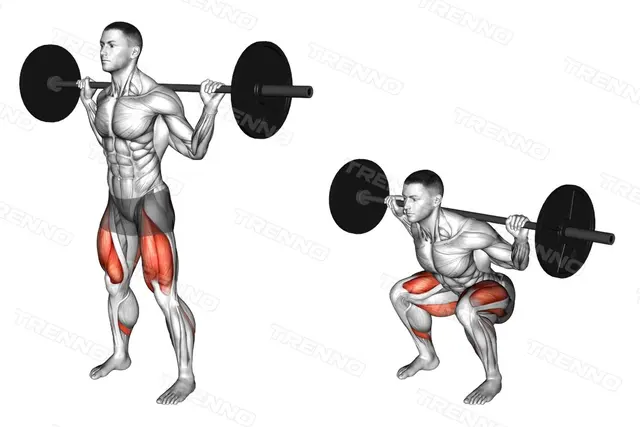
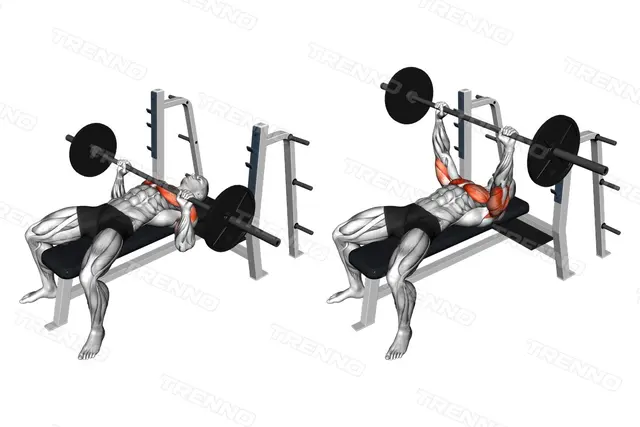
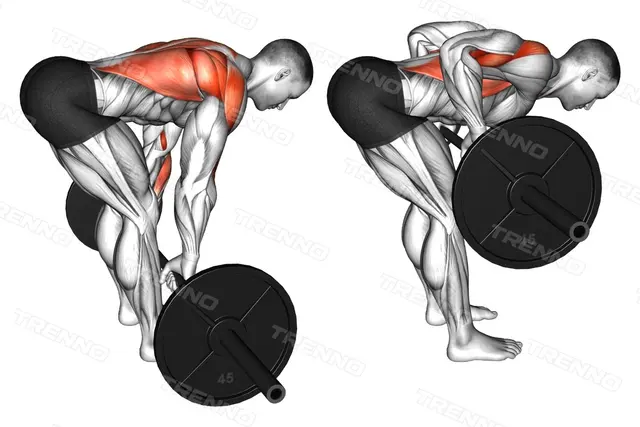
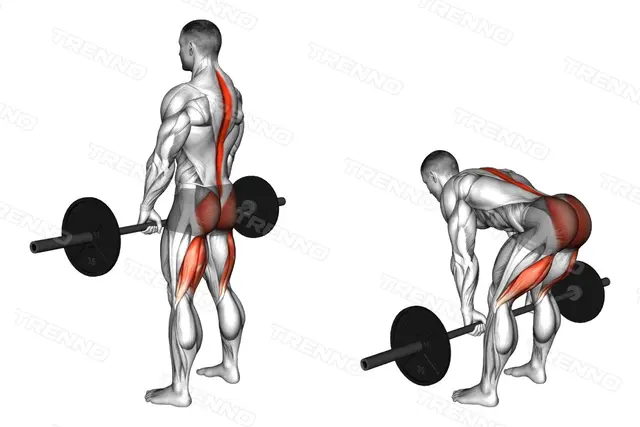
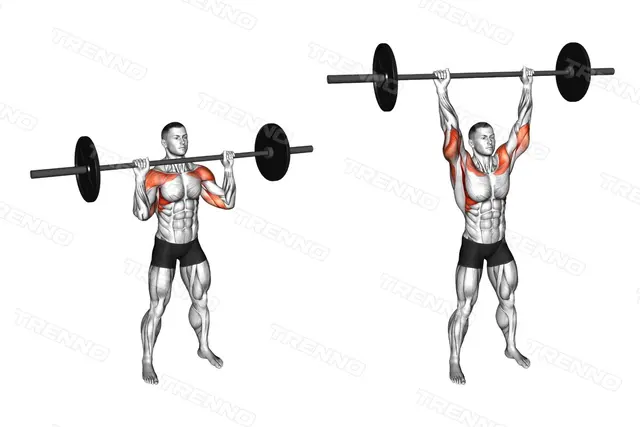
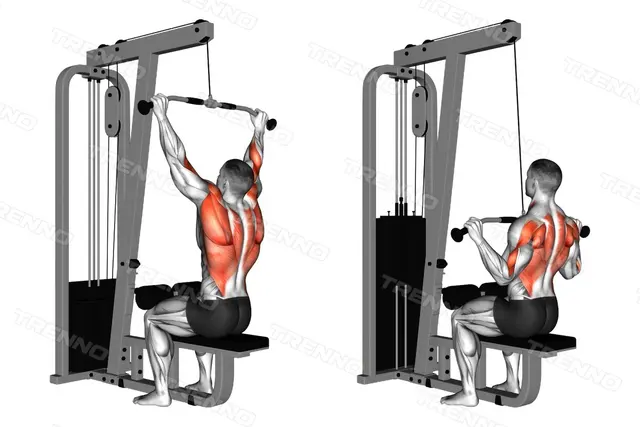
Beginner Full-Body Barbell, 3 days trains on three days with a day between them, Monday, Wednesday and Friday for example, with five exercises and 15 working sets a session. The first day is built on the Barbell Back Squat, the Barbell Bench Press and the Bent-Over Barbell Row; the second on the Deadlift, the Standing Barbell Overhead Press and the Lat Pulldown; the third on the Leg Press, the Incline Barbell Bench Press, the Seated Cable Row and the Romanian Deadlift; each ends with a machine or a core exercise. Counted from its rows, the week gives the chest 6 hard sets, the back 9, the quadriceps 9 and the hamstrings 6: the range above, with room to grow into. By the arithmetic Trenno uses for a routine’s Duration, a session takes about 40 to 45 minutes, warm-up sets included.
Your first twelve weeks could run like this:
| Weeks | What to do |
|---|---|
| 1 and 2 | Learn the lifts and find your weights, stopping three or more reps short |
| 3 to 8 | Add reps, then weight, ending sets one to three reps short |
| 9 to 12 | Keep adding; if a lift stalls for two sessions, check sleep and food before anything else |
| After 12 | Take a lighter week, then run the program again from heavier weights, or move to a split |
Food and sleep
Training starts the process; food and rest finish it.
- Protein. A 2018 meta-analysis of 49 studies with 1,863 people found that extra protein added to the gains from resistance training, and that intakes above about 1.6 g per kilogram of body weight a day added nothing more to lean mass. Protein from ordinary food counts toward that total.
- Spread it. A 2018 review suggests about 0.4 g per kilogram in each of at least four meals to reach that total. For someone of 70 kg (about 155 lb), that is about 110 g a day, or four meals of about 28 g.
- Sleep and rest days. They are when the rebuilding happens; Muscle Recovery has the signs that you need more.
Cardio does not stand in the way: combined with lifting, it cost no muscle in the research; Cardio Before or After Weights? has the details.
How to apply it
- Choose one program from the table and give it twelve weeks.
- Put the days in your calendar, spread through the week.
- Warm up the first lifts with a few lighter sets, as in Warm-Up Sets.
- Write down every set. Next session’s weights come from this session’s numbers; How to Keep a Workout Log shows what to record.
- Add reps, then weight, and let the log tell you when.
Trenno is built around this loop. Every program above is in Explore; starting one asks which days you train and fills the calendar. In a workout, each set shows what you did last time beside the empty one, the rest timer starts when you tick a set, and the programs’ warm-up sets arrive already marked. The target range sits in the reps cell, so you can see when every set has reached its top.
Mistakes and myths
- Changing programs every few weeks. Progress comes from adding to the same lifts; a new program resets the numbers you were building.
- Too much, too soon. Twenty sets per muscle in the first month is far more than a beginner needs. Start at the bottom of the range.
- Every set to failure. Stopping a rep or two short built as much muscle in the studies, with less fatigue.
- “You need supplements to grow.” Total protein is what counts, and ordinary food can provide it.
- Judging by one week. Muscle is built over months. Judge the trend in your log, not a single session.
FAQ
How many days a week should a beginner train?
Two or three full-body days. Two meet the guidelines and build muscle; three make room for more sets.
Should a beginner lift heavy or light?
Moderate: sets of 6 to 15 that end close to failure. Heavier sets build strength sooner, lighter ones take longer and burn more, and both build muscle.
How much protein do I need?
About 1.6 g per kilogram of body weight a day, spread over three or four meals. More than that added nothing in the meta-analysis above.
Can I build muscle at home?
Yes. Dumbbells or your own body weight build muscle when the sets are hard, and two of the programs in the table need nothing more.
Do I need a split?
Not at first. Full-body sessions two or three times a week train every muscle often with few sets each time, which suits a beginner.
Sources
- Currier BS, D’Souza AC, Singh MAF, et al. American College of Sports Medicine Position Stand. Resistance Training Prescription for Muscle Function, Hypertrophy, and Physical Performance in Healthy Adults: An Overview of Reviews. Medicine and Science in Sports and Exercise, 2026.
- Schoenfeld BJ, Ogborn D, Krieger JW. Dose-response relationship between weekly resistance training volume and increases in muscle mass: A systematic review and meta-analysis. Journal of Sports Sciences, 2017.
- Schoenfeld BJ, Grgic J, Krieger J. How many times per week should a muscle be trained to maximize muscle hypertrophy? A systematic review and meta-analysis of studies examining the effects of resistance training frequency. Journal of Sports Sciences, 2019.
- Bull FC, Al-Ansari SS, Biddle S, et al. World Health Organization 2020 guidelines on physical activity and sedentary behaviour. British Journal of Sports Medicine, 2020.
- Morton RW, Murphy KT, McKellar SR, et al. A systematic review, meta-analysis and meta-regression of the effect of protein supplementation on resistance training-induced gains in muscle mass and strength in healthy adults. British Journal of Sports Medicine, 2018.
- Schoenfeld BJ, Aragon AA. How much protein can the body use in a single meal for muscle-building? Implications for daily protein distribution. Journal of the International Society of Sports Nutrition, 2018.