The shoulder muscle, the deltoid, has three parts, and a normal week trains them very unevenly. Every press works the front. The overhead press also works the side, which the bench press barely touches, and no press does much for the rear. Here is how to split the sets between the three, the exercises that reach each one, and a week that puts them together.
The short answer
Give the shoulders about 10 to 20 hard sets a week over two sessions, but not evenly. One overhead press, 3 or 4 sets, covers the front, which also gets half a set from every bench press. Spend the rest on the side and the rear: 3 to 6 sets a week of lateral raises and 3 to 6 of rear-delt flies or face pulls, in sets of 12 to 20 reps that end one to three reps short of failure.
The shoulder muscles
The front part of the deltoid raises the arm forward and helps in every press. The side part lifts the arm out to the side; it is the part that makes the shoulders look wider. The rear part draws the arm back and out, and works in rows and face pulls. The upper trapezius, which shrugs the shoulders, sits above them and is filed under the back in our library. The exercises for the deltoids are under Shoulders.
What the studies found
The American College of Sports Medicine’s 2026 position stand, an overview of 137 systematic reviews, found more muscle growth with 10 or more sets per muscle group a week, from light or heavy loads alike when the sets were hard. For the shoulders, most studies used electrodes, which show how active a muscle is during a set rather than how much it grows:
- Presses reach the front, raises the side and the rear. In 13 trained men, the shoulder press worked the front delt hardest, and the lateral raise and the shoulder press the side delt. The bench press worked the front delt about as hard as the lateral raise did, but barely touched the side and the rear.
- Keep the arm neutral in a raise. In 10 competitive bodybuilders, the lateral raise with the arm neither turned in nor out worked the side delt harder than the raise with the arm turned out, with bent arms, or the front raise. Turning the arm in moved work to the rear delt, the upper trapezius and the triceps.
- Dumbbell or cable, the same growth. In an 8-week trial, 24 trained men and women raised one arm with a dumbbell and the other with a cable, 5 sets twice a week. Both sides’ side delts grew alike, by about 3 to 5 percent.
- Standing or seated. In a study of four presses, pressing dumbbells standing, the least steady version, worked the delts hardest but moved the least weight; seated, people pressed about 10 percent more with the same dumbbells.
Six exercises for bigger shoulders
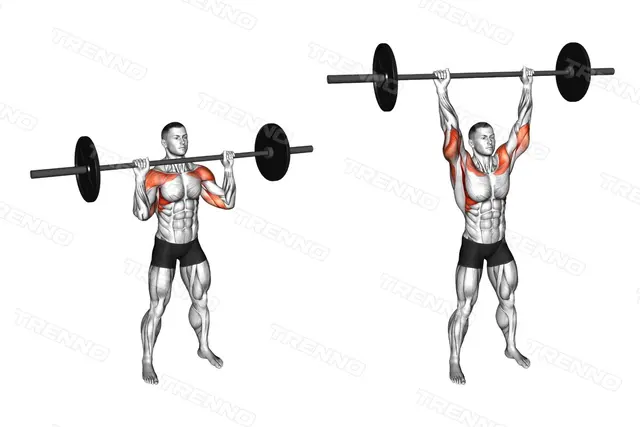
- Standing Barbell Overhead Press. The heavy press for the front and the side, with the whole body braced. Cue: press straight up, move the head back as the bar passes, then push it through under the bar.
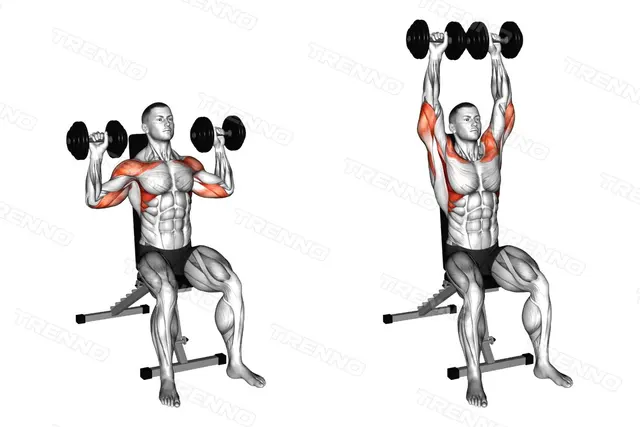
- Seated Dumbbell Overhead Press. A back pad takes the legs and the trunk out of the press. Cue: keep the ribs down against the pad and lower to the shoulders with control.
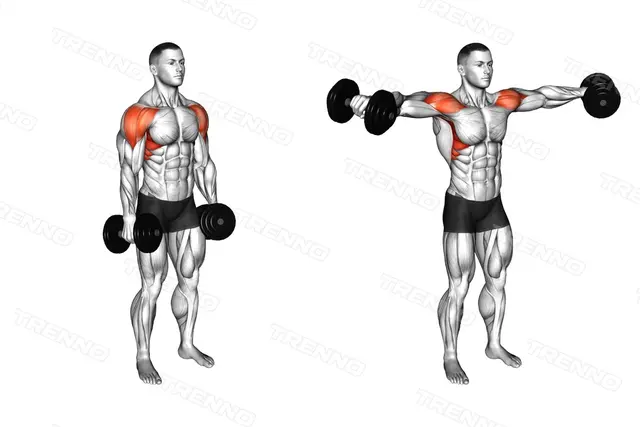
- Dumbbell Lateral Raise. The side delts’ main exercise. Cue: lead with the elbows, the hands a little below them at the top, and lower slower than you lifted.
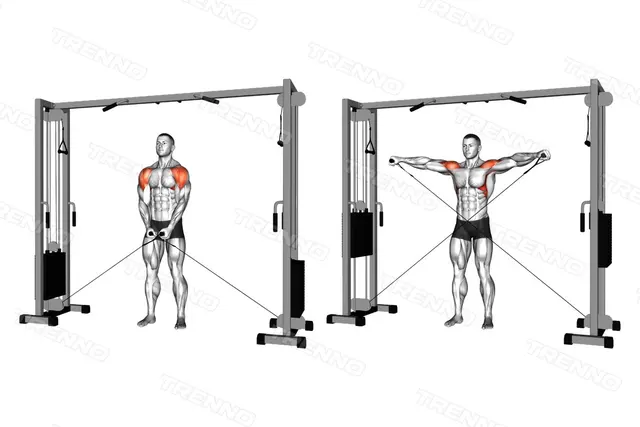
- Cable Lateral Raise. The cables keep the tension at the bottom, where a dumbbell lets it go. Cue: both arms out to shoulder height, the handles crossing back in front on the way down.
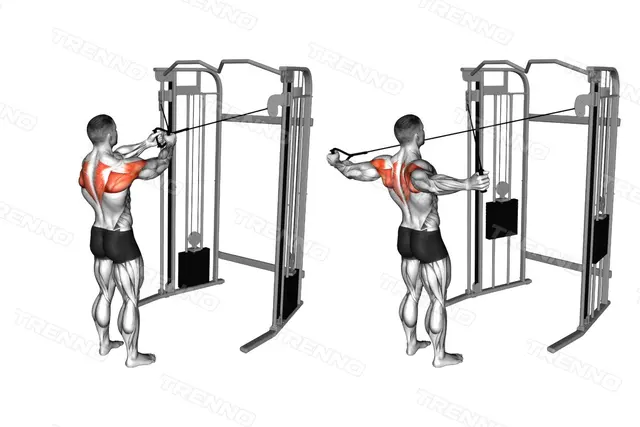
- Cable Rear Delt Fly. The rear delts on their own. Cue: open the straight arms out to a T and pause there, elbows soft.
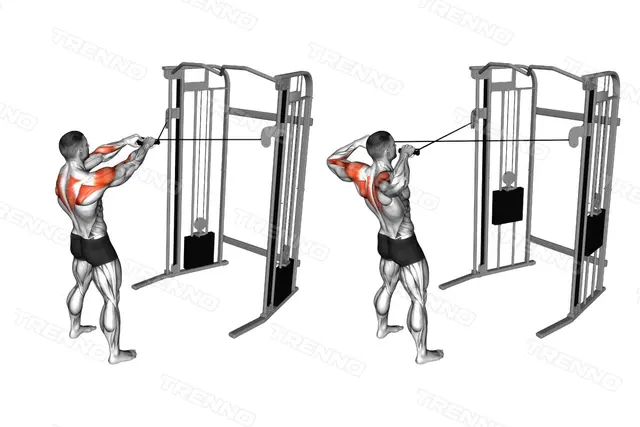
- Face Pull. The rear delts and the middle back together. Cue: pull the rope toward your face, split the ends past the ears and keep the elbows high.
What it means for your week
Four of our programs, counted from their rows, by the sets each part of the shoulder gets a week:
| Program | Overhead presses | Lateral raises | Rear delts |
|---|---|---|---|
| Push Pull Legs, 3 days | 3 | 3 | 3 |
| Upper/Lower, 4 days | 4 | 3 | 3 |
| Body-Part Split, 5 days | 7 | 4 | 6 |
| Push Pull Legs, 6 days | 7 | 6 | 6 |
On top of the presses, the front delts get half of every chest press: 3.5 more sets a week in Intermediate Push Pull Legs, 3 days, 6.5 in the Body-Part Split, 5 days. The Shoulders Day of the Body-Part Split gives 14 sets in one session, from the heavy seated press and the machine press to lateral raises and rear-delt flies, and its back day adds face pulls. Advanced Push Pull Legs, 6 days spreads 19 sets over four days. How to count the rest of your muscles is in How Many Sets per Muscle per Week.
A two-session week
Add these blocks to two sessions you already do, such as a push day and a pull day:
| Session A | Session B | |
|---|---|---|
| Front | Standing Barbell Overhead Press, 3 × 6 to 10 | From the day’s bench press |
| Side | Dumbbell Lateral Raise, 3 × 12 to 20 | Cable Lateral Raise, 3 × 12 to 20 |
| Rear | Face Pull, 3 × 15 to 20 | Cable Rear Delt Fly, 3 × 15 to 20 |
That is 15 sets a week: 3 for the front, 6 for the side and 6 for the rear, the front’s half sets from your bench press on top. Rest two and a half minutes after the press and a minute after the raises and the flies, the rests our programs use.
In Trenno, every exercise keeps its own rest timer, so the press can rest two and a half minutes and the raises one in the same session. Tap the figure on a workout’s totals card, or on a finished workout, and Muscle Distribution shows the shoulders’ sets, a bench press counting there as part of a set.
How to progress
Lateral raises and flies use light weights, so the next dumbbell can be a big jump: from 6 kg (about 13 lb) to 8 kg is a third more. Add reps up to the top of the range first, and move up only when every set gets there with the same clean form; on a cable, move one plate. The overhead press follows double progression with the smallest plates you have. Progressive Overload has the rest of the method.
Mistakes and myths
- Only pressing. Presses train the front and some of the side, and hardly the rear. Without raises and flies, the rear gets almost nothing and the side only what the overhead press gives.
- Shrugging the raise. When the shoulders rise toward the ears, the upper trapezius does more of the work. Lower the weight and keep the shoulders down.
- Swinging heavy dumbbells. Momentum lifts the weight past the hardest part. Pick one you can raise and lower under control.
- Turning the arm in at the top. It shifted work from the side delt to the rear delt and the trapezius in the study above. Keep the arm neutral.
FAQ
Do I need front raises?
Usually not. The presses already work the front hard, and the front raise mostly worked the front delt and the chest in the raise study above. Add it only if the front of your shoulders lags.
Dumbbells or cables for lateral raises?
Either. Both grew the side delts alike in the trial above. Use whichever you can load in small steps.
How many times a week should I train my shoulders?
Once or twice. At the same weekly sets, the number of sessions made little difference in a 2019 meta-analysis of 25 studies. Two sessions keep each one shorter.
Sources
- Currier BS, D’Souza AC, Singh MAF, et al. American College of Sports Medicine Position Stand. Resistance Training Prescription for Muscle Function, Hypertrophy, and Physical Performance in Healthy Adults: An Overview of Reviews. Medicine and Science in Sports and Exercise, 2026.
- Campos YAC, Vianna JM, Guimarães MP, et al. Different Shoulder Exercises Affect the Activation of Deltoid Portions in Resistance-Trained Individuals. Journal of Human Kinetics, 2020.
- Coratella G, Tornatore G, Longo S, Esposito F, Cè E. An Electromyographic Analysis of Lateral Raise Variations and Frontal Raise in Competitive Bodybuilders. International Journal of Environmental Research and Public Health, 2020.
- Larsen S, Wolf M, Schoenfeld BJ, et al. Dumbbell versus cable lateral raises for lateral deltoid hypertrophy: an experimental study. Frontiers in Physiology, 2025.
- Saeterbakken AH, Fimland MS. Effects of body position and loading modality on muscle activity and strength in shoulder presses. Journal of Strength and Conditioning Research, 2013.
- Schoenfeld BJ, Grgic J, Krieger J. How many times per week should a muscle be trained to maximize muscle hypertrophy? A systematic review and meta-analysis of studies examining the effects of resistance training frequency. Journal of Sports Sciences, 2019.